Showing posts with label barefoot horse. Show all posts

11 December 2015

After a year of farrier science.

    Last year, (2014) we realized that we had to do something about Raven's feet. I've documented it before. 

    He was trimmed last month, I've just now gotten around to writing it up.

    With good trimming, and supplementing his diet with biotin, Raven's feet have improved immeasurably.

    I wish I had started taking decent pictures of them in November 14, when we first began a dedicated course on fixing his feet. Thus, the pictures that are usable begin in January.

  It's been a year. Here is what we began with in January 15, and what we have now:

Left hind outside post trim Jan 15

Left hind outside post trim Nov 15

Left hind inside pre-trim Jan 15

Left hind inside post trim Nov 15

Right Hind outside pre trim Jan 15

Right hind outside post trim Nov 15

Right hind inside post trim Jan 15

Right Hind inside post trim Nov 15

     As the television ad used to say, isn't that amazing?. With the exception of the RH outside, these are now normal hooves. The RH outside seemed to have weaker hoof growth.Not sure why, but horses feet are individuals. So Mark plans on putting shoes on the hind feet for maybe two trims, just to bolster that last bit that needs to grow out. 

   Over and over again, I am amazed..and grateful that we ditched the old farrier for Mark. Old Farrier was over his head with Raven's feet. They were so very bad...the pics in January don't do it justice. We cleared up the white line disease. We got rid of the thrush. Little by little, Mark has reshaped the hoof, bringing the lines back into alignment, putting those heels back on the ground where they belong.
Raven is going much better now. I'm sure he's forgotten how bad his feet were. 

   Will I take more pictures on his next trim in February? Probably, but whether I post or not, I don't know. After all, with the exception of the RH outside, these are GOOD FEET.

31 August 2015

My farrier works miracles (slowly)

   I have to 'post and boast'.

Raven the Beautiful 

     Look at this gorgeous beast. This was taken in July at a local dressage test. Raven was wired to the max. My gosh, he was high voltage. Sue even wondered if she should do the second test on him, he was so much horse. But we encouraged her to do the test and she came out of it with some very high marks indeed.

     I have made some big steps in riding him. I took a lesson from our super trainer and she's helped me a lot. I am even riding him at the trot bareback, having finally been able to make that transition. Literally. 
My hardest part right now is collection. I still don't have that feel for when he's truly up underneath me. As I noted in my last post, he is not an easy horse to ride. He's long backed, which makes it more difficult for him to collect, and I'm not rider enough..yet... to know it when he is.
But when I do it right, and we're trotting, suddenly it's easy to ride him. Those moments are fleeting yet exhilarating when they do come. They keep me motivated.

      Last year at this time he had just settled into his new home at New Barn. In January we realized that his feet were deteriorating so quickly that soon he would be lame. So we changed farriers. Matt, our new farrier, took Raven's feet as a challenge and ...well, here are some photos of then and now.

     I have, in the past, kept a running account of the progress on his feet. I will condense that to the worst of his hind feet, the left hind. This is a picture of his hoof from January 2015, after we'd been dinking around with the feet for six months of the old farrier. I cannot remember if this was taken before his trim or after. I believe, judging from the fuzz on the ground, that it was after. It was also after we'd given up on the epoxy in his feet.
 
Left hind outside January 2015  
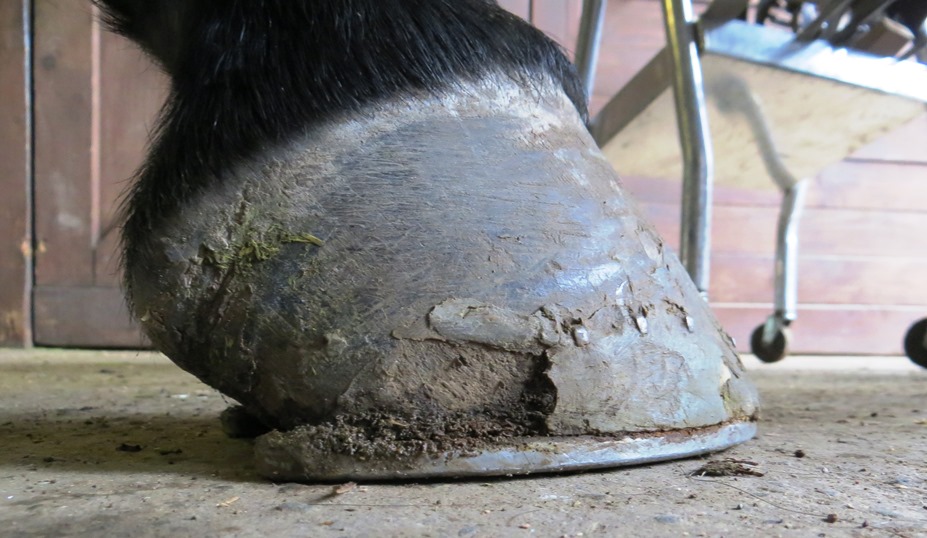
      I still cringe when I look at this. It was so bad. It had white line and, now we know, thrush as well. The crevices were from nail holes that had rotted out. Literally. So we took him out of shoes permanently. Old farrier had steadfastly warned us that "this horse can never be barefoot." With this foot, there was nothing left for a nail to hold onto, as was evidenced in the right hind, which isn't pictured here.

       Now look at this same hoof, 7 months later, after trimming:
Left hind outside post trim August 2015


 To quote an old tv ad.."Isn't that amazing'"

     It IS. We've been feeding him Trifecta, a supplement that contains biotin. We know now that he must have biotin for the rest of his life. Small price to pay for a good hoof. 
We also give most of the praise to Matt, our Wonderful Farrier. He had the courage to take on these ugly feet. We obeyed his 'commands' in dosing the white line, the thrush, and keeping the hoof dry with his concoction of Venice Turpentine/Iodine. 

    What? Yes, it is. It's the same foot. I swear. 

     Matt has done miracles. Notice how he also has slowly improved the angles of the foot to what they're supposed to be. Old farrier had paid so much attention to the 'rotten' parts of the hoof that he trimmed them to the point where there was no heel contact. The heels were contracted. 
     Matt has gently and slowly brought the hoof back into alignment. The heels are opening nicely and in contact with the ground now. He will never go back into shoes. He doesn't need them, and in another few months we hope to take his fores out of shoes, too. The only problem they had was again, Old Farrier had trimmed them to the point where they were beginning to club. 

   Raven is very happy in his new feet. Earlier this month, he was busting around in his paddock with his buddy and tore up the outside. But it was, in my opinion, the very last parts of the old bad hoof. Within days the bent up portion had worn off without damaging the underparts.

   These are new feet. 

    I'm telling you. If and when you find a GOOD farrier, treat him like a king. (well, you know what I mean.) Matt has our business for as long as he wants to keep us. They're minting new veterinarians every year, but I cannot think of more than one young man who is taking on the job of farrier. Every other one is in his early fifties and older. Horseshoeing is part science, part experience, part empathy, and a little bit witchcraft. It uses the same tools as from five hundred years ago. It's archaic. It's also a science, and an art. When you find that man who can do the job right, treat him nicely. You won't regret it. 
 

21 March 2015

Encouraging signs of improvement in Raven's feet


     While none of us (me, Sue or Raven) have a bit of the Irish in us, still, St. Patrick’s day brought good news. Matt, our farrier, came out to trim and shoe Raven.

    We’ve been faithful in applying the goop (60/40 iodine/Venice turpentine). This has resulted in an almost complete cure of the white line disease in his hind hooves. 

    Instead of putting shoes back on the feet, we decided to put them in 'easy boots'.

   This rubber slipper is well known to endurance riders, but it works just as well on a dressage horse with raggedy feet. This is perhaps the fifth or sixth generation of easy boot. First hitting the market waaaaaaaaay back in the 80’s, they were difficult to put on and remove, and made the horse’s hoof sweat. I remember pouring a cup of water from a horse’s easy boot.


 The boot technology has improved remarkably. This style is cinched down using Velcro. They seem to breathe much better, and perhaps the only problem is they are inclined to accumulate dirt inside. But we take them off every night, to let Raven’s feet breathe. We also apply the goop once his feet are cleaned off.

    They worked. Not only did they allow Raven’s hooves to grow out but they also kept his hooves dry. That helped the goop kill the white line. 

    They also protected his feet from sustaining anymore damage from our rocky soil. In fact, they did so well that his hind feet had developed a 'lip' (for lack of a better term) on the bottom of the hoof. 

   I took pictures of his feet on the 15th, before the trimming, and the 17th, afterwards. For some reason, some of the ones I took of the inside of his right hind didn't register on the memory card. 

   No matter. You can see a lot of new hoof growth coming down from the coronet. Matt is very encouraged at the progress that's been made on Raven's feet.


 If you look at the edge of the above photo of his left hind, you can see the 'lip". It's on the toe. This specific photo was taken 15 Mar 15. Below is the same foot,left hind outside, after trimming.


Compare it with the one below, from my post "A picture can cause a 1000 shrieks".
What an improvement!! And below is the photo of his sole, that I shot on 15 Mar 17. The odd coloration is due to the hoof goop's iodine, staining the tissue. I did NOT take pictures of the sole after Matt worked on it. Linea, the barn owner, has a sea of dogs who insist on being underneath one's feet.
When you squat down to take a picture of feet, the dogs take it as an invitation to kiss you. I hate being kissed by a dog. So the pictures didn't get taken.
But you can see that much of the 'garbage', as Matt calls the infected hoof, is gone.


 Below are shots of his right hind, taken last month (or was it January?), which wasn't as bad as the left, but was still not a very good hoof.


    And now, the same hoof as above, before trimming on 15 Mar:
I don't have pictures of this right hind hoof after trimming, but if you look closely, you can see a bit of the lip. Below is the right hind sole from 15 Mar, and you can see the lip on both the right hind and left hind sole.
   We are tickled at the progress that's been made. Even Linea came over and wanted to know what Matt thought. Matt, was..well, encouraged, but wasn't effusive. He's seen a lot of bad feet, and so he advises we stay the course. We'd love to take Raven out of shoes altogether. After coaxing these feet into growing better hoof, I cringe at the idea of putting new holes in them.


    Oh, I forgot to mention, we've also been feeding him a supplement called "Trifecta". It is way spendy, oh my gosh, but it certainly seems to be contributing to the new hoof growth. 

    It seems to me that the right hoof is growing out faster than the left. 
That's merely my pondering, though.

   I wish I'd taken pictures of the soles after trimming. Matt took off the bars. I don't think this is a good idea, but...what do I know. He seems to be fixing the feet, so....I'll keep my humble opinions to myself. 

    Next hoof trimming is on 5 May. The weather is improving and he's been on green grass for some time, so I imagine that will speed up hoof growth, a lot. We'll see.


05 February 2015

A picture can be worth a thousand shrieks

    "The continuing saga of Raven's feet". 

    Last week, Matt the Farrier returned to work on Raven's feet.
(see "A silver lining to white line disease").

    I was able to take decent photos of his feet this time.

    In  a way, I wish I hadn't.
    Take a look at these and tell me they don't make you cringe.


      EEEK.

     Especially the last one...that nail end was a tendon ripping, artery opening accident waiting to happen.

     I can't tell from the first series of photos how bad they were. The damage was hidden in part by the epoxy from earlier sessions. We were focusing too closely on the white line to really pay attention to this.

     But, again, things aren't as bleak as they may appear.

     The white line is almost gone. Matt dug out just a little bit in both hind hooves. It's almost cleared up. 
     Raven's hoof angles are improving measurably. Not only can we see that the heels are opening up and actually impacting the ground when we're holding a hoof,  we (I) can see it in the way he moves.

    Even before Matt came back for this latest session, I could see Raven feeling 'happier' in his feet. Watching Sue ride as often as I do, I've learned what is normal for Raven. Up until now, he's always dragged those hind hooves. You could see long, shallow grooves left from them as he trotted (in a freshly raked arena). I'd watch the puffs of dirt rise up from them as he trotted on hot dry days. His hooves were burnished on the fronts. In other words, he's always dragged his feet.

    But last month, watching him move under saddle, I saw something different. Not as much dragging, in fact, hardly any dragging at all. Instead, when they trotted past me, I'd see: shoes. Four of them, not two in front and just a suggestion in the back. His trot has developed more bounce, more rhythm, more balance. His whole body language said that he was feeling more comfortable in his feet. 

   Matt was early, as usual. (it's so nice to have a farrier that not only is on time, but is sometimes early).  He got right to work on Raven's feet. This time we were going to do something different. We decided to let Raven's back feet go barefoot.

   There's a lot of argument regarding barefoot horses. My last owned horse, Jordan, had feet like rocks. My farrier at the time would bitch that he had to use his harder rasp on Jordan, a CMK Arabian. Within six months of buying Jordan, I realized he didn't need shoes, and had them pulled. He went barefoot for the rest of his life and was quite happy. So was I: shoes are expensive. I kept him trimmed every 8 weeks.

   Alas, Raven isn't so lucky. He's 1/2 Trakehner, 1/2 Thoroughbred. He has the TB speed and the TB feet-meaning they're not as tough as one would wish. 

    The Last Farrier, a well meaning man, advised Raven NEVER go barefoot. But as I've discussed earlier, I'm convinced that he was unintentionally the reason for the problem. He was right: Raven's feet were so bad that going barefoot would have been disastrous. 

    
    I'm a big fan of letting a horse go barefoot, especially if he's not going to be used for trail riding. But I also understand, now, that many horses just cannot go barefoot. Five thousand years of domestication has given us a wonderful animal and friend, but it came with a price in the form of anatomical and conformational weaknesses.

  There's a mindset among some horsemen that NO horse should wear shoes. 

   The 'natural shoeing' set think that a horse is a horse, but they're not. Basing their ideology on the legendary toughness of mustang's feet, they insist that all horses can and should be barefoot. 
But they are wrong. The reason the mustangs that were examined and their feet extolled over are mustangs that had good feet. Mustangs with bad feet DIE.  (I think one of the wierdest things I ever saw was a mustang at the BLM with a split hoof. I mean, split in two, toe to heel. The only reason he was alive was that he'd been rounded up). The basic premise of natural selection is that the sick, the old and/or the disabled animal is the one that is picked off by a predator.

   Domesticated horses are bred for many things, but never, as far as I can tell, solely for good solid feet. So they don't have them. While I don't like it, I understand that most horses NEED shoes. We ask too much of their feet: carrying us as well as the horse, on unnatural surfaces, in unnatural conditions, applying unnatural forces, keeping them confined in small paddocks or worse, in stalls,  in too soft, too wet, too dry, and trimming them as well as we are able and not always succeeding.  That is where all our foot problems arise. Shoeing and improper trimming exacerbates an already poor hoof. 

   If you still doubt me, consider Homo sapiens. Us. Chances are you grew up in what we consider 'first world' conditions-you lived in a house, you walked on sidewalks, you started wearing shoes at a very early age. Your feet look 'normal' to you, until you look at the feet of someone from, say, Kenya, a person who grew up never wearing anything more substantial than a pair of flipflops. 


    Humans who have never worn shoes have feet that look almost deformed to us. Their toes and feet splay out. They are the natural human foot, a part of the human body that was never meant to be shod. WE shod humans are the ones with the deformed feet.

    People who grow up in warm climates, such as that found in Africa, living in poor rural communities, often never wear a shoe. They might not be able to afford shoes, but they are also in a place where they don't need them. It pays off, too. Let's consider the  Thoroughbreds of the human species, Kenyans. When it comes to running long distance marathons, there's the Kenyans, and then there are the also rans, all us white folk who seldom went barefoot, bringing up the rear. The Kenyans sometimes run the marathons barefoot. 

I believe they compete in the Olympics barefoot. When they compete in our marathons,  (you will please forgive the pun, but I can't resist) they are a shoe in. They're so far ahead of the rest of the runners that, several years ago, some boneheaded racist tried to make a rule that any Kenyan that ran in the Boston Marathon be disqualified solely because everyone knew they'd beat all the white (and black) Americans by many, many minutes. Thankfully the dipshits were shouted down and, hopefully, run out of town on a rail. I have no patience whatsoever with racists.The point being, Kenyans win. Every time. It's because they grew up in natural feet.

   The above photos were captured from the net and I'm sorry but I cannot find any citations of the original posters. The first is fairly recent, showing the feet of two Africans who are showing normal, never shod feet. 
   The middle picture was taken as part of a study of the human foot done in the early 1900's. It shows a picture of an African person who'd never worn a shoe in his or her life.  The third one shows a pair of normal, never shod feet in fig. 1, and, in Fig. 2  a pair of shoes or boots that look all too familiar to shoes of today (especially high heeled ones and cowboy boots) and the third showing the resulting pair of feet from wearing such footwear. 

  See the differences? That's what happens to feet. As they grow, they're formed by the footwear. Our feet, while they grow throughout our lifetime, can and do change but it's usually in response to wearing shoes. I don't believe that they can revert to the natural form. Horses, though, have a different foot that changes shape to suit the environment. 

   That doesn't mean that there's not a propensity for the 'natural shoeing' mindset to also afflict human runners.

     There are millions of runners/joggers in the US. You can see them everywhere-running in parks, alongside roads, running with dogs, pushing strollers, running fast, jogging slowly-but moving at a fast clip-in shoes. 
     
  About two years ago, the 'natural running' fad hit the US. 

   Someone who obviously had good feet to begin with came up with the idea that we should all be running barefoot. We were "designe to run barefoot."  (you will excuse the term: I don't believe in 'creation science' or 'intelligent design". One look at our bodies will tell you that if we were designed by some creator, he was insane. Bluntly put, we evolved.)
We DID evolve to run barefoot. But civilization changed that, as it has changed everything else about us. 
    The barefoot running craze hit-and lasted perhaps one season. People who ran in shoes for miles without pain had it forcibly proved to them that running barefoot is a terrible idea.

    The instances of foot injuries skyrocketed. Podiatrists were inundated with runners who had shin splints, bone spurs, plantar fasciaitis, torn ligaments, green stick fractures of the tibia, sciatica, broken ankles, people with hip, back and neck injuries-all due to trying to be something they aren't: barefoot runners. That's just skeletal injuries: skin damage from our relatively filthy roads, strewn with gravel, rocks, broken glass, pieces of metal, dog dung, pollutants such as oil, you name it, it was on the roster. Feet that had carried their owners for miles, were suddenly sources of pain and medical emergencies because they had been forced to be barefoot. You can't unscramble an egg, and you can't run barefoot if you've been wearing shoes all your life.  

    We are so formed by shoes that one day, I was forced to walk about in my rubber boots without my orthotics in them. One day. And the next week I was in great pain and so lame I could barely walk.  


    Back to the topic! 

    Once Matt had pulled the shoes and the epoxy, I took photos...and am still cringing at the damage still evident from bad shoeing and the white line disease. Yet underneath, the sole is improving, and Raven is growing the hoof out at a good pace. 

   He dug out what was left of the white line. The feet are looking better even though, externally, they look dreadful. 

   Matt, however, was so encouraged by the real improvements he's wrought in Raven's feet that he decided to forego the epoxy, for now...and let the horse go barefoot. (in the rear only).

    We decided to let the hooves grow out without shoes. NOT, though, unshod. No, we put him in boots. They're rubber overshoes.  Matt insisted we keep applying the white line killing stuff and to keep the hooves dry. We are making progress. Spring and summer are coming, and with the warmer weather, his feet will grow faster. We take them off at night when he's in his stall to let his feet breathe and dry out. (because he sweats in them, a bit).

    He seems quite content to be in them. It sounds odd to hear him walk..instead of that sweet, sweet 'clip clop' (a sound so near to my heart that it probably could replace my own heartbeat) and is now a "clip fwub clip fwub". 

   We're getting there. Next trimming, I'll post more photos.