Showing posts with label farrier. Show all posts

11 January 2018

They can hear us think, you know


Here’s the real scenario:

Last fall, Matt, our farrier, came to shoe and trim two horses: Raven, and Laddie.

You know who Raven is, and he is always well behaved when anyone does anything to him, be it farrier work, floating, etc. 

Laddie is the newest horse in the barn. He is an immense, 17.2 hand Thoroughbred. I believe he’s about 16 years old and is/was an eventer.

O, Laddie’s owner, had seen Matt work on Raven in the past and decided she wanted him to do Laddie. 

Matt –who, like me, is beginning to feel his age and is trying to cut down his workload-asked her how she came to contract him to shoe Laddie. She said Barnlord had told her about his work. I admit, Matt is probably the best farrier I’ve ever been lucky to have.  

Laddie began to act up almost immediately. Tossing his head, flicking the tools out of Matt’s hands, tried to back up, etc.  He has white line disease in his hind feet and acted as if the methylene blue (that purple stuff that has a staining radius of fifty feet) hurt. 

As the process wore on, Laddie got worse and worse. He literally yanked his feet out of Matt’s hands, reared, kicked and tried to bolt. What should have taken no more than half an hour took twice that.
Matt later told me that afterward, he felt as if he’d been hit by a pair of linebackers..and Matt is a big, bear of a man, a burly cowboy/farrier, tough as nails. 

Yesterday, I walked into the barn. The barnlord’s farrier, Bob, was shoeing and trimming a big bay horse. 

Barnlord was holding his lead rope. The horse had his head down and was half asleep. It took me a couple seconds to realize it was Laddie.

“Holy cow, what did you do, sedate him?”
“No.”

Laddie was acting like any good horse, calm, patient, willing to accept anything Bob did to him.

What was the difference?

No, it wasn’t the farriers. 

It was the owner.

O wasn’t present for the trimming this time. 

O is the 22 year old daughter of some very wealthy, upper crust blue bloods back somewhere in New England (on the US East Coast.)

She drives a Mercedes. She bought a truck and a  horse trailer when she got here.  Her parents are paying her way through college. They paid to ship Laddie out here to the West Coast (something that is NOT cheap). They are paying for her rented HOUSE, and the barnlord sends all bills to the parents, not O.

O has very obviously lived a life of ease. She’s accustomed to “people”...a nice way of saying servants or employees..taking orders from her and doing things that she is too high society to do. 

She demonstrates no sense of responsibility. She is passive-aggressive-sometimes arrogantly insisting she knows everything about horses, and other times, completely ignoring the needs of her horse. Laddie was on the point of foundering and barnlord insisted O call a vet. O refused. He’s done this before, she said, all he needs stall rest. She wrapped some vet wrap around his fore pasterns as if that would fix it. 

Barnlord got pissed, and after O left, she called a vet, who got to the barn in time to prevent any damage. 
She billed O’s parents. She also, later, told O that she is NOT O’s servant, that O needs to accept responsibility for her horse. O...ignored her. 

O doesn’t really like Laddie, by the way. She’s taken him out eventing precisely once since she got to the barn last year. Laddie’s blanket is in tatters. She doesn’t care. She can easily afford a new one, but, she doesn’t care. 

And that’s the point.

We humans project energy without knowing. Horses pick up on it. You can’t lie to a horse. If you have had an argument with your husband, and are still stewing about it, you’re mentally broadcasting it to every living being in the  barn. 

 I think we humans are immune to it. We have to be, we’d go insane if we heard every other humans thoughts. But animals aren’t immune. They HAVE to hear in order to survive. Most dogs easily prove it. How many times have you experienced or  heard "my dog knows when I'm coming home."?  I think dogs are smart enough to know you’re not pissed at them, but horses aren’t. All they ‘hear’ is that you are angry, aggressive, and scary.

As well, if you don’t particularly like the horse, he’s going to pick up on that, too. He’s had prior experiences with unfriendly humans broadcasting their non-physical aggression, and he knows, now, that some humans are things to be feared.

It’s not just horses that ‘hear’ our thoughts. Wild animals are especially sensitive. 

We feed the wild birds. The deer have learned that there’s free food under the feeders. We have a group of six or seven black-tailed deer (depending on how many fawns the does produced last spring) that live on my property. If I walk out to the feeders and look hard at the deer, as if sizing them up for an attack, they bolt. If I merely glance at them, AND allow the damned earworm in my head to play or...if I mentally do my times tables (“2 times 3 is 6, 2 times 7 is 14”), they not only are unafraid, they come closer, waiting for me to dump the feed so they can feast.

(Excuse me while I boast...I no longer need to do that. They are accustomed to us trudging through the rain and snow with a pair of feed buckets that they barely wait for us to spread the feed before they’re in it. )

When Matt was there to shoe Laddie, O was supposed to handle her horse. While she did so, he began to act up. She slapped at Laddie, cussed him out, shrieked at him, and literally drove him crazy. He kept pulling his feet out of Matt's hands, making it almost impossible to nail a shoe on.
When a 17.2 horse rears and waves his size 3 hooves around your ears, it turns into a dangerous situation. 

Matt, being the conscientious man he is, carried on, but when he was finished he told her straight up, “don’t call me again. I’m never touching this horse again.”

O got pissed. She didn’t say anything but later, Barnlord said O complained to her about Matt being “incompetent’. 

I had left by then so I didn’t hear it. Which is okay, because Matt would rather she think him incompetent than risk getting hurt by her horse. 

When Bob came out to shoe Laddie, O...who had promised to be there but then decided to skip it, there was just me, Barnlord and Bob.  No one slapped Laddie. No one shrieked at him. Barnlord held the lead and expected Laddie to mind his manners like the good horse he is. She and the farrier had a long conversation about something other than the horse in front of them, and Laddie dropped his head and half slept,  as ho hum as Raven always is. 

They hear us and react. Keep a rein on your emotions.

11 December 2015

After a year of farrier science.

    Last year, (2014) we realized that we had to do something about Raven's feet. I've documented it before. 

    He was trimmed last month, I've just now gotten around to writing it up.

    With good trimming, and supplementing his diet with biotin, Raven's feet have improved immeasurably.

    I wish I had started taking decent pictures of them in November 14, when we first began a dedicated course on fixing his feet. Thus, the pictures that are usable begin in January.

  It's been a year. Here is what we began with in January 15, and what we have now:

Left hind outside post trim Jan 15

Left hind outside post trim Nov 15

Left hind inside pre-trim Jan 15

Left hind inside post trim Nov 15

Right Hind outside pre trim Jan 15

Right hind outside post trim Nov 15

Right hind inside post trim Jan 15

Right Hind inside post trim Nov 15

     As the television ad used to say, isn't that amazing?. With the exception of the RH outside, these are now normal hooves. The RH outside seemed to have weaker hoof growth.Not sure why, but horses feet are individuals. So Mark plans on putting shoes on the hind feet for maybe two trims, just to bolster that last bit that needs to grow out. 

   Over and over again, I am amazed..and grateful that we ditched the old farrier for Mark. Old Farrier was over his head with Raven's feet. They were so very bad...the pics in January don't do it justice. We cleared up the white line disease. We got rid of the thrush. Little by little, Mark has reshaped the hoof, bringing the lines back into alignment, putting those heels back on the ground where they belong.
Raven is going much better now. I'm sure he's forgotten how bad his feet were. 

   Will I take more pictures on his next trim in February? Probably, but whether I post or not, I don't know. After all, with the exception of the RH outside, these are GOOD FEET.

31 August 2015

My farrier works miracles (slowly)

   I have to 'post and boast'.

Raven the Beautiful 

     Look at this gorgeous beast. This was taken in July at a local dressage test. Raven was wired to the max. My gosh, he was high voltage. Sue even wondered if she should do the second test on him, he was so much horse. But we encouraged her to do the test and she came out of it with some very high marks indeed.

     I have made some big steps in riding him. I took a lesson from our super trainer and she's helped me a lot. I am even riding him at the trot bareback, having finally been able to make that transition. Literally. 
My hardest part right now is collection. I still don't have that feel for when he's truly up underneath me. As I noted in my last post, he is not an easy horse to ride. He's long backed, which makes it more difficult for him to collect, and I'm not rider enough..yet... to know it when he is.
But when I do it right, and we're trotting, suddenly it's easy to ride him. Those moments are fleeting yet exhilarating when they do come. They keep me motivated.

      Last year at this time he had just settled into his new home at New Barn. In January we realized that his feet were deteriorating so quickly that soon he would be lame. So we changed farriers. Matt, our new farrier, took Raven's feet as a challenge and ...well, here are some photos of then and now.

     I have, in the past, kept a running account of the progress on his feet. I will condense that to the worst of his hind feet, the left hind. This is a picture of his hoof from January 2015, after we'd been dinking around with the feet for six months of the old farrier. I cannot remember if this was taken before his trim or after. I believe, judging from the fuzz on the ground, that it was after. It was also after we'd given up on the epoxy in his feet.
 
Left hind outside January 2015  
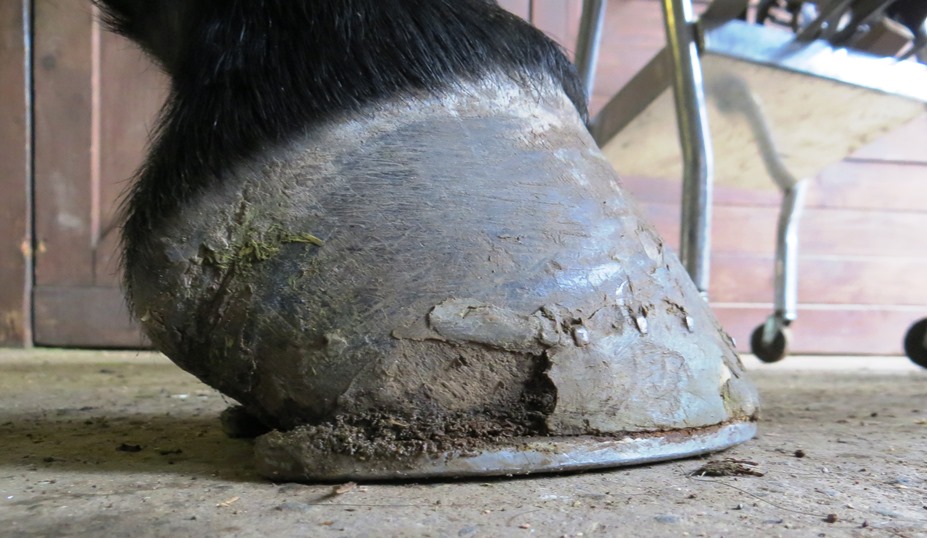
      I still cringe when I look at this. It was so bad. It had white line and, now we know, thrush as well. The crevices were from nail holes that had rotted out. Literally. So we took him out of shoes permanently. Old farrier had steadfastly warned us that "this horse can never be barefoot." With this foot, there was nothing left for a nail to hold onto, as was evidenced in the right hind, which isn't pictured here.

       Now look at this same hoof, 7 months later, after trimming:
Left hind outside post trim August 2015


 To quote an old tv ad.."Isn't that amazing'"

     It IS. We've been feeding him Trifecta, a supplement that contains biotin. We know now that he must have biotin for the rest of his life. Small price to pay for a good hoof. 
We also give most of the praise to Matt, our Wonderful Farrier. He had the courage to take on these ugly feet. We obeyed his 'commands' in dosing the white line, the thrush, and keeping the hoof dry with his concoction of Venice Turpentine/Iodine. 

    What? Yes, it is. It's the same foot. I swear. 

     Matt has done miracles. Notice how he also has slowly improved the angles of the foot to what they're supposed to be. Old farrier had paid so much attention to the 'rotten' parts of the hoof that he trimmed them to the point where there was no heel contact. The heels were contracted. 
     Matt has gently and slowly brought the hoof back into alignment. The heels are opening nicely and in contact with the ground now. He will never go back into shoes. He doesn't need them, and in another few months we hope to take his fores out of shoes, too. The only problem they had was again, Old Farrier had trimmed them to the point where they were beginning to club. 

   Raven is very happy in his new feet. Earlier this month, he was busting around in his paddock with his buddy and tore up the outside. But it was, in my opinion, the very last parts of the old bad hoof. Within days the bent up portion had worn off without damaging the underparts.

   These are new feet. 

    I'm telling you. If and when you find a GOOD farrier, treat him like a king. (well, you know what I mean.) Matt has our business for as long as he wants to keep us. They're minting new veterinarians every year, but I cannot think of more than one young man who is taking on the job of farrier. Every other one is in his early fifties and older. Horseshoeing is part science, part experience, part empathy, and a little bit witchcraft. It uses the same tools as from five hundred years ago. It's archaic. It's also a science, and an art. When you find that man who can do the job right, treat him nicely. You won't regret it. 
 

03 June 2015

What a difference a good farrier can make

     Raven has had 'bad feet' for many years. I've written about them before on this blog, so I'm merely going to condense things down a bit.

    When Raven was being shod by the "old" farrier, that man...well, he didn't help the feet at all. A case could be made that he exacerbated what was already a bad hoof. Raven had picked up white line disease somewhere that had steadily eaten away the hind feet. The 'old" farrier, rather than take measures to treat the white line, merely packed the holes in the hoof with some sort of epoxy. 
   I'm not slamming the old farrier. He meant well, but he was in above his head with Raven's feet. He just didn't know how to 'fix' them. The epoxy was meant to hold the shoe on the hoof, nothing more. I do believe that the old farrier knew how to shoe horses with good feet, but problem feet were beyond his capacity to rectify. 
   
   The epoxy kept the hoof in one piece for about a month, then would start crumbling away. In addition, the epoxy sealed the white line IN, making it even worse. 
To add to the problems, the old farrier had trimmed the hooves so that the heels weren't contacting the ground, meaning: contracted heels. 

   By the time we moved Raven to the New Barn, his feet were a dreadful mess. 

   Sue, by this time, had conquered her feelings of guilt regarding 'firing' the old farrier. She didn't want to hurt his feelings and had continued on with him,more, I suspect, out of a feeling of sympathy for him and accepting that he wasn't fixing the hooves.  He was the only farrier she'd ever had. She had nothing to base it on.

   So it was fortuitous that we moved Raven to the New barn about the same time as the old farrier hurt his back and shoulders so badly that he was forced into (perhaps permanent) retirement. This was Sue's out. I told her, farriers lose and gain customers all the time. It won't hurt his feelings. 

   We also found Matt, the 'new' farrier, at the new barn.

   The differences were amazing. Matt, being a professional, didn't say anything about the work of the old farrier, but he probably silently whistled in amazement. And joy...this was going to take some time. And cost money.
   How this horse managed to function with his feet in such bad shape was, in his words, 'amazing.' And a testament to the horse...Raven's a trooper. 

   He was upfront with us. It was going to take a year of frequent trimmings, and a change in feed to get Raven's feet back to something resembling 'good' hoof.

    We put him on Trifecta, a supplement that costs a lot. 

   And so it has proved. At first Matt put a different sort of epoxy in the hoof. This was to hold a shoe on and hopefully, provide some sort of support. He taught us the formula for killing the white line: 60/40 blend of Iodine/venice turpentine. Put it on the hoofs OFTEN, not on the coronary band, and keep the feet dry. 

   The first several trimmings consisted of cutting out as much rotten (there's no other word for it) hoof as possible, and replacing the shoes.

    But the shoes weren't holding. And the hooves were too badly deteriorated to benefit from any support the epoxy may have provided.
    
    So...let's go bold and remove the shoes altogether. The old farrier had warned Sue, never ever let this horse go barefoot. That, to me, had been an alarm bell.  But I said nothing. I'm not a farrier, and Raven's only mine by Sue's kindness. I was glad when Matt said, let's  take the shoes off. It would give the hooves a chance to grow out without the nails putting torque on the new growth.  

    By this time it was January and cold, and the white line didn't like being  poisoned or frozen. 

    The epoxy didn't, either. It kept falling out, taking hunks of hoof with it. Those hunks were dead hoof. Yes, hoof is already dead, but this was just shitty hoof to begin with.

   So in March, we made the decision to cease using the epoxy all together, continued applying the goop, and put Raven in Easy Boots.

    April's trimming showed a lot of improvement. We kept him barefoot. The white line was almost gone.

   In May, the Easy Boots weren't working so well anymore. One can only clean them so often, then the Velcro stays gritty. The grit started wearing sores on his heel bulbs. That hurts. 
   With clean Easy Boots (we had two pair) I could see he felt better by just watching him move. For the first time, when Sue trotted past me, I could see the soles of his hind feet. That had never happened before. He'd always dragged the hind feet. 

    Here's a picture of Sue on Raven taken in May. He's in Easy Boots.
 
Picking up his hind feet at last!


  He told us his feet felt better by acting like a fit horse. Lots of running and bucking in his paddock with his new paddock mate, Zeke, put a lot of wear and tear on the Easy Boots. He wore them out!


   So we took him out of Easy Boots and Sue began putting cast tape on the feet. This stuff looks like vet wrap but is what 'they' use to set broken arms and legs these days. You apply it wet and it dries into a stiffened 'cast'. That stuff went on the hoof well and could be kept off any skin or tissue. It worked well but his toes wore through and then he'd lose the cast. I'd find it in his paddock, the inside a perfect match for his frog. But when it came time to remove it for trimming, Matt had to literally rasp it away. Which is why the last photo I'm posting on this blog shows blue dust below the hoof.

   2 June 15's trimming was a revelation. I am posting four pictures of the left outside hind, from January to June. (mostly because I have about sixty pictures, taken over the months, and just don't want to post the whole series). The left hind outside was always the worst of the hooves. The new growth and improvement in the foot his amazing. The white line disease is GONE in all his feet. We are letting him go barefoot for a week, because the tape...while it protected his growing hooves, was also making the frog a bit 'soft'. So right now he's barefoot on the hind and shod on the front feet.  If going barefoot shows signs of buggering up the edges of the hoof, we'll put him back in tape. 

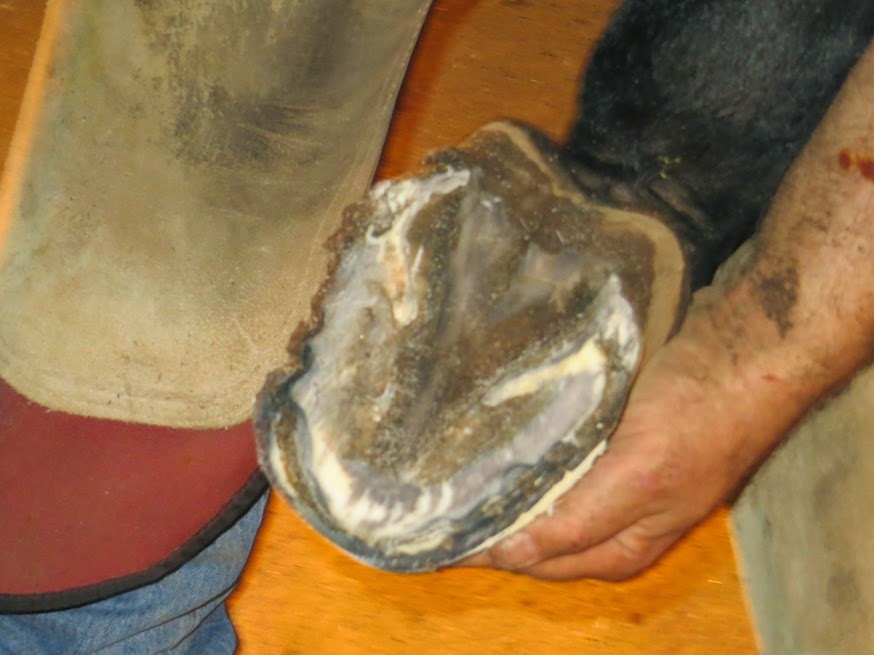
   But look at the improvements!! The outside hind is looking almost normal. I'm posting pictures of the right hind sole. One is of the sole taken Nov 14. The last was taken on 2 June. The white line is gone. Oh my gosh.
Left hind outside January 15

 
Left Hind outside after trimming March 2015

   
Left Hind outside before trimming 29 April 15

Left Hind outside after trimming (note blue fibers from cast) 2 Jun 15


Right Hind sole showing white line all through sole November 2014


Right Hind sole after trimming 2 Jun 15


    It's so encouraging when someone can make a horse's feet RIGHT. Matt's our MAN.

21 March 2015

Encouraging signs of improvement in Raven's feet


     While none of us (me, Sue or Raven) have a bit of the Irish in us, still, St. Patrick’s day brought good news. Matt, our farrier, came out to trim and shoe Raven.

    We’ve been faithful in applying the goop (60/40 iodine/Venice turpentine). This has resulted in an almost complete cure of the white line disease in his hind hooves. 

    Instead of putting shoes back on the feet, we decided to put them in 'easy boots'.

   This rubber slipper is well known to endurance riders, but it works just as well on a dressage horse with raggedy feet. This is perhaps the fifth or sixth generation of easy boot. First hitting the market waaaaaaaaay back in the 80’s, they were difficult to put on and remove, and made the horse’s hoof sweat. I remember pouring a cup of water from a horse’s easy boot.


 The boot technology has improved remarkably. This style is cinched down using Velcro. They seem to breathe much better, and perhaps the only problem is they are inclined to accumulate dirt inside. But we take them off every night, to let Raven’s feet breathe. We also apply the goop once his feet are cleaned off.

    They worked. Not only did they allow Raven’s hooves to grow out but they also kept his hooves dry. That helped the goop kill the white line. 

    They also protected his feet from sustaining anymore damage from our rocky soil. In fact, they did so well that his hind feet had developed a 'lip' (for lack of a better term) on the bottom of the hoof. 

   I took pictures of his feet on the 15th, before the trimming, and the 17th, afterwards. For some reason, some of the ones I took of the inside of his right hind didn't register on the memory card. 

   No matter. You can see a lot of new hoof growth coming down from the coronet. Matt is very encouraged at the progress that's been made on Raven's feet.


 If you look at the edge of the above photo of his left hind, you can see the 'lip". It's on the toe. This specific photo was taken 15 Mar 15. Below is the same foot,left hind outside, after trimming.


Compare it with the one below, from my post "A picture can cause a 1000 shrieks".
What an improvement!! And below is the photo of his sole, that I shot on 15 Mar 17. The odd coloration is due to the hoof goop's iodine, staining the tissue. I did NOT take pictures of the sole after Matt worked on it. Linea, the barn owner, has a sea of dogs who insist on being underneath one's feet.
When you squat down to take a picture of feet, the dogs take it as an invitation to kiss you. I hate being kissed by a dog. So the pictures didn't get taken.
But you can see that much of the 'garbage', as Matt calls the infected hoof, is gone.


 Below are shots of his right hind, taken last month (or was it January?), which wasn't as bad as the left, but was still not a very good hoof.


    And now, the same hoof as above, before trimming on 15 Mar:
I don't have pictures of this right hind hoof after trimming, but if you look closely, you can see a bit of the lip. Below is the right hind sole from 15 Mar, and you can see the lip on both the right hind and left hind sole.
   We are tickled at the progress that's been made. Even Linea came over and wanted to know what Matt thought. Matt, was..well, encouraged, but wasn't effusive. He's seen a lot of bad feet, and so he advises we stay the course. We'd love to take Raven out of shoes altogether. After coaxing these feet into growing better hoof, I cringe at the idea of putting new holes in them.


    Oh, I forgot to mention, we've also been feeding him a supplement called "Trifecta". It is way spendy, oh my gosh, but it certainly seems to be contributing to the new hoof growth. 

    It seems to me that the right hoof is growing out faster than the left. 
That's merely my pondering, though.

   I wish I'd taken pictures of the soles after trimming. Matt took off the bars. I don't think this is a good idea, but...what do I know. He seems to be fixing the feet, so....I'll keep my humble opinions to myself. 

    Next hoof trimming is on 5 May. The weather is improving and he's been on green grass for some time, so I imagine that will speed up hoof growth, a lot. We'll see.


04 January 2015

The silver lining of white line disease


    It's an education, to watch a horse move (while being ridden). I won't say I'm an expert, far from it. It takes many years to really absorb the gestalt of the motion of a horse. Veterinarians and farriers both need that ability to see a horse move without knowing the horse. I will readily admit that when I massaged, I would ask to have a horse walked/trotted out, but I won't admit that I always knew what I was seeing when I saw it. 

 I will never be the level of a dressage judge, someone who is able to see the most minute of actions, one who seems able to to see the slightest hesitation or disobedience, or the proper collection.

    Such fine discernment is, for the moment, beyond me.

    But I'm learning, and it comes from watching Raven move.

    He's off and on lame these days. The vet diagnosed arthritis in his left fore and he's now on Adequan, a monthly medication that seems to be working.

    But what else seems to be working is Matt The Farrier's work.

   I've written about Raven's hoof woes earlier. We realize, now, that Raven has a case of white line disease, and has had it for a while. Why we didn't see it earlier, I don't know. Maybe because neither Sue nor I had ever seen it before? 
It appears that it's not a bad case. As is usually the case with veterinarians, ours refuses to definitively state it is 'white line'. Matt the Farrier "thinks" it's white line and gave us the recipe for the hoof goop to doctor it. We've talked to other folks who've 'had' white line, they've looked at Raven's feet and scratched their heads and said, "I dunno, it could be, what does the vet say?"

   So we're operating on the assumption that it is white line, and are doctoring accordingly. 

   That stuff WORKS. Again, it's a 60/40 blend of Venice turpentine/iodine, applied to the outside of the hoof no higher than the shoe nails, and on the sole of the hoof. Try not to get it on the frog and for god's sakes DON'T get it on the coronary band.

   It's working, especially in our winter climate of rain and never ending dampness.

   What also is working is Matt's trimming of and building up the crumbling hind feet. He trims out the 'garbage', as he terms it, then applies an epoxy of some sort (god help me, it smells like Bondo, but I know it's not, but it is similar in texture and action). Then he nails on the shoe and we keep Raven in his stall for 24 hours until the bondo (let's call it that) cures and hardens.

   It's working.

   Yesterday we rode bareback, as it was so very cold. Sitting on a nice warm, fuzzy horse keeps you nice and toasty. The other person sits on the mounting block, wrapped up in Raven's blanket. While Sue rode, I watched. (as an aside, a few months ago, she was riding and asked me if she was crouching in the saddle. I said, "I dunno, I was watching Raven". What! You were watching the HORSE?   (laughing))

   I noticed that he is trotting more comfortably now. He's picking his hind feet up now, whereas before, with his too tight shoes, he would drag them. In fact he'd drag his hind feet so much that the hoof wall was burnished from the sand in the arena. He seems to be a lot happier now, now that his hoof angles are being changed, with every trimming, to something more normal.

   I can't help but blame the old farrier. Bless him, he meant well, but...Sue's been using that farrier since 2009. Hence, Raven's feet have been slowly but relentlessly 'forced' to into an unnatural position and form. Again, this isn't malfeasance by the old farrier. 


    If you've ever been foolish enough to attempt to give yourself (or someone else) a haircut, you know that, unless you know what you're doing, you botch the job. You take a little too much hair off here, so you have to take some more off on the other side to balance it, take off a little too much there and before you know it, you or your poor victim is either bald or butchered.

    Like any other craft, farrier is a combination of art and science. Once you've learned it, you don't have to relearn it..but you really do. Science, research and understanding of how hooves grow has mushroomed in the last ten years. We know so much more. There's fads, such as 4 Point Shoeing, or "natural shoeing",  that neglect to understand that a mustang that doesn't grow a fabulous hoof doesn't live long. Domestication has changed the horse in many ways, to include the feet. You cannot expect a horse with a thousand years of domestication behind it to have feet like a mustang. 

   But fads have their place in expanding the entire sphere of understanding. Incorporating new information, i.e. fads, into the base of the science, is what makes for better farrier science.

    Farriers, when they learn and hone their trade, are going to go down a certain path of knowledge, empiricism, and experience. Like the old saying, sometimes you can't teach an old dog new tricks. I was guilty of that close mindedness as a massage therapist. I learned how to massage a horse a certain way, and when I see someone else massaging a horse, I immediately go into Professional Mode, thinking, "Why is he doing it THAT way? I wouldn't have started there, I always start on the brachycephalicus...". I have to stop myself with a mental admonishment...like riding, there's many ways of massaging a horse. The end result is what is important, not how you got there. 

    Did it ever occur to me to go back to school? Why? When I knew my way around a horse so well I could (and did) massage horses in the dark? The idea never occurred to me. Now the point is moot, as I've permanently retired from massaging horses. My shoulders just cannot handle it anymore. I don't have the upper body strength anymore. 

    Even so, I was wrong. Perhaps going back to school after 16 years of massaging would have been beneficial to me and my clients.  I learned this from my decision, at the advanced age of 49, to go back to college to finally get my degree in Biology.

   I was born a biologist, studied biology for the love of it, throughout my life. I absorbed it like a green leaf absorbs sunshine, and have never not loved it. I thought going back to school was merely a formality, merely being able to legally put BS after my name. I thought going back to school could teach me nothing I didn't already know. And yes, much of it was merely refreshing what I already knew. However, biology has exploded in the last twenty years.  I learned a ton of new information, new elucidations of things I'd never thought of. I learned a LOT of Biology that I didn't know I didn't know. 

  Perhaps that was the problem with the old farrier. He'd always trimmed that way. He knew Raven's feet from years of trimming them. He knew his work. He didn't have to relearn how to trim a hoof. Nor, to give him the benefit of the doubt, did he have time or the money to stop working to go back to farrier school. One, there aren't very many farrier schools left. No one is teaching anymore. Two, trimming and shoeing horses is the way he makes his living. Being self-employed is a bitch of a way to live-everything depends on you working. Your bills need paying, your family needs to be housed and fed, everything depends on your working. You don't have the luxury of taking six months off to relearn a few things.

  Hoof trimming/shoeing is an art. A farrier is a combination of barber, sculptor and machinist. In all three fields, one changes the shape or appearance of a substance by removing large parts of it.   

   That's what hoof trimming is. You have to remove parts of the hoof. The hoof has grown back since the last trimming, faithfully traveling the path you gave it when you trimmed it last time.  A little error from the  last trimming is compounded now, because if you take too much off, then you have to balance it on the other side..and there you have it. For better of worse, the hoof is going to grow in the path you've chosen for it. Sometimes that path is the wrong one.

   Shoes must be forced into a shape that approximates the sole of the hoof wall. Steel, being unforgiving, is going to force the hoof to grow to suit the shoe. Thus you have two competing forces: the living biological process of growth meeting the unyielding plate of steel. 


   So it was for Raven. The old farrier could only trim the way he'd taught the hoof to grow, and shoeing it was the capstone of the process. You have to make the shoe fit the hoof.

  Consequently, Raven's feet weren't shod 'correctly'. By the time we realized his hooves were really bad, it was very  late in the game. 

  Where did he pick up white line? Who knows. 

   In a way, perhaps the white line was a blessing in disguise. Seeing hunks of hoof come away with the removal of the shoe is never a good feeling, but by removing the deformed and diseased hoof, it gave Matt the opportunity to begin remodeling the hoof. Artificial hoof (i.e. the bondo) will hold a shoe and still allow the hoof to grow. Bondo doesn't give a damn that the steel shoe is unyielding. It's as artificial as the steel. It allowed the hoof to heal and regenerate.
 
   Feeding him supplements to improve hoof growth, working him regularly and gently, and keeping his feet as dry as possible, has helped.

  
   Finally, I'm tickled that I've developed a better eye for how a horse moves. That's the icing on the cake.
  

06 November 2014

The trouble with feet.

     Raven has been in the New Barn for two months or so. Within a week of arrival, he'd torn out the electric fence in his paddock during a fracas with the geldings in the paddock next to his; somehow knocked out a couple fence boards; and unfortunately, strained a ligament in his left fore while acting Big Stud For The Girl Next Door.

     It took a few weeks of confinement to the small turnout pen off his stall and an injection in order for it to heal. But he did heal. So we began to ride, only to discover a new issue: his hind feet are crumbling.


Arrrghhhhhhhhhhh. It's a very bad feeling to see the farrier pull a shoe and part of the hoof falls off.


This comes from one or several of factors: Our wet, wet climate, genetics (to a degree), nutrition, and shoeing.
    In my opinion, it's a combination of 1 and 4. I know Raven's breeding. He's 1/2 Trakehner, 1/2 Thoroughbred. He has virtually no white anywhere on him-just a spot on his lip and a faint star, just a scattering of white hairs that vanish under a winter coat.

     I know what he's been eating for two years. We have never stinted on the best for him. In fact, Sue moved him from Bourbon Stables after the owner decided to save a few bucks (and still charge the same money) by going cheap on feed.  Raven went from locally grown orchard grass and whole oats to the equine equivalent of Doreetohs and Fruit Loups.  (sic) (I misspell purposefully in order to keep the advertisers from hitting you and me with ads.)

Our wet climate keeps the feet wet. Farrier number 1 warned us to keep Raven's  feet as dry as possible. But there's only so much you can do when you live in a gigantic car wash. You don't want to keep him in a stall 24/7. That drives them insane. And kills them.

    Because Sue's former farrier has been unable to work because of his wrists and back, she had to find a new one. After doing a lot of culling, she hired Matt.


     Despite my not being a farrier, I always wondered about how the last farrier shod Raven. He'd always had to build up one of the hind feet with a bit of epoxy, but now it'd gotten much worse.

    In such a small field of work, every farrier knows every other farrier in the region. So Matt was very circumspect in his appraisal of why the hooves are crumbling. He didn't say so, but I know he believes the former farrier was partially to blame. Nor did he imply it in order to keep a new client. He was late to the barn because his prior appointment, one for four horses, was suddenly doubled to eight when 'everyone realized the farrier was there and would you please work on my horse?" I can't blame him for saying yes.


   The discussion between the three of us touched on how Raven had been shod before Matt got the job. Maybe the first farrier didn't allow the heels to adequately expand. Maybe he put too much pressure on the sides. I don't know. But now we have about a year of work to get his feet to grow out. Matt built up the hooves with epoxy and gave me a recipe for goop to put on his hooves to keep them dry, because if 'he stands around in the mud, that epoxy is going to come right out."

    Yes. The recipe is: Mix Venice turpentine and iodine in a 60:40 ratio. For us in the US, that's a cup of turpentine to 5.5 ounces of iodine.

Apply to the soles and on the outside of the hoof, no higher than the nails. Do NOT get it anywhere near the coronary band, as it will burn the tissue. Venice turpentine is made of larch tree resin. Be careful when shopping for it. It's different than the more readily available turpentine used by painters. Venice turpentine is an astringent, and the iodine is to kill bacteria that every horse steps in every single moment of his life. Try not to get it on the frog. Apply about three times a week. (this last is for Raven's case.)

    It could have been worse. Sue doesn't vanity clip him. Meaning, she leaves his whiskers on and never, ever trims his pasterns.


     Some people think that cowlick of hair coming off the back of his pastern is unsightly, and trim it off. Yes, it makes for a 'cleaner, prettier' leg, but that cowlick serves a very important purpose...like a rain chain, it wicks water away from the hoof.


     Extrapolating this in my biologists mind, I wonder if draft horse breeders didn't understand this when they set about breeding draft horses. One can't think of Clydesdales, Shires, and even Friesians without thinking of their 'feathers' (extremely long haired pasterns)

    Sue is upset about it, but I try to tell her it will be okay. It will take time and work, but we'll get him back to good footing. Literally.