Showing posts with label hoof. Show all posts

11 December 2015

After a year of farrier science.

    Last year, (2014) we realized that we had to do something about Raven's feet. I've documented it before. 

    He was trimmed last month, I've just now gotten around to writing it up.

    With good trimming, and supplementing his diet with biotin, Raven's feet have improved immeasurably.

    I wish I had started taking decent pictures of them in November 14, when we first began a dedicated course on fixing his feet. Thus, the pictures that are usable begin in January.

  It's been a year. Here is what we began with in January 15, and what we have now:

Left hind outside post trim Jan 15

Left hind outside post trim Nov 15

Left hind inside pre-trim Jan 15

Left hind inside post trim Nov 15

Right Hind outside pre trim Jan 15

Right hind outside post trim Nov 15

Right hind inside post trim Jan 15

Right Hind inside post trim Nov 15

     As the television ad used to say, isn't that amazing?. With the exception of the RH outside, these are now normal hooves. The RH outside seemed to have weaker hoof growth.Not sure why, but horses feet are individuals. So Mark plans on putting shoes on the hind feet for maybe two trims, just to bolster that last bit that needs to grow out. 

   Over and over again, I am amazed..and grateful that we ditched the old farrier for Mark. Old Farrier was over his head with Raven's feet. They were so very bad...the pics in January don't do it justice. We cleared up the white line disease. We got rid of the thrush. Little by little, Mark has reshaped the hoof, bringing the lines back into alignment, putting those heels back on the ground where they belong.
Raven is going much better now. I'm sure he's forgotten how bad his feet were. 

   Will I take more pictures on his next trim in February? Probably, but whether I post or not, I don't know. After all, with the exception of the RH outside, these are GOOD FEET.

31 August 2015

My farrier works miracles (slowly)

   I have to 'post and boast'.

Raven the Beautiful 

     Look at this gorgeous beast. This was taken in July at a local dressage test. Raven was wired to the max. My gosh, he was high voltage. Sue even wondered if she should do the second test on him, he was so much horse. But we encouraged her to do the test and she came out of it with some very high marks indeed.

     I have made some big steps in riding him. I took a lesson from our super trainer and she's helped me a lot. I am even riding him at the trot bareback, having finally been able to make that transition. Literally. 
My hardest part right now is collection. I still don't have that feel for when he's truly up underneath me. As I noted in my last post, he is not an easy horse to ride. He's long backed, which makes it more difficult for him to collect, and I'm not rider enough..yet... to know it when he is.
But when I do it right, and we're trotting, suddenly it's easy to ride him. Those moments are fleeting yet exhilarating when they do come. They keep me motivated.

      Last year at this time he had just settled into his new home at New Barn. In January we realized that his feet were deteriorating so quickly that soon he would be lame. So we changed farriers. Matt, our new farrier, took Raven's feet as a challenge and ...well, here are some photos of then and now.

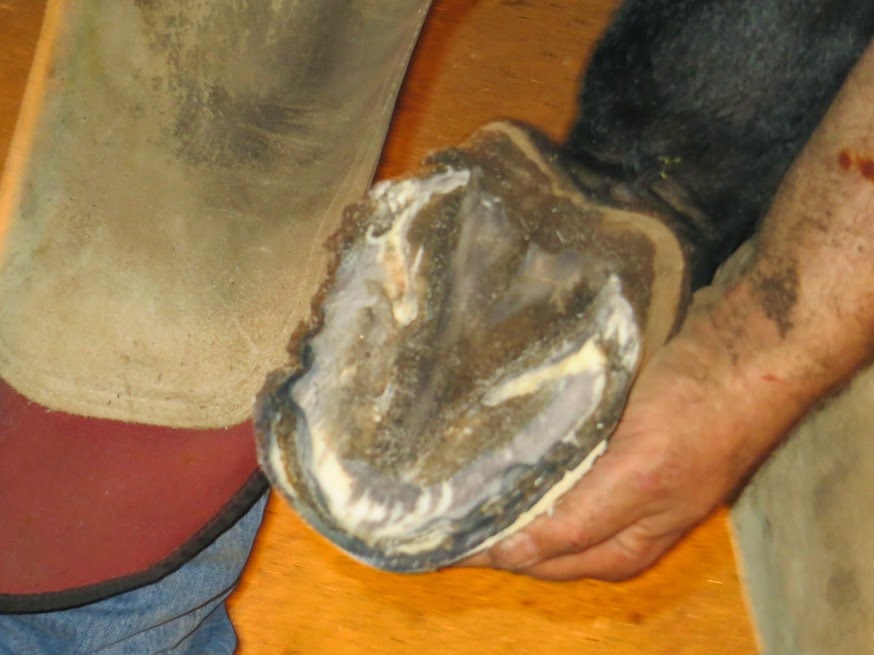
     I have, in the past, kept a running account of the progress on his feet. I will condense that to the worst of his hind feet, the left hind. This is a picture of his hoof from January 2015, after we'd been dinking around with the feet for six months of the old farrier. I cannot remember if this was taken before his trim or after. I believe, judging from the fuzz on the ground, that it was after. It was also after we'd given up on the epoxy in his feet.
 
Left hind outside January 2015  
      I still cringe when I look at this. It was so bad. It had white line and, now we know, thrush as well. The crevices were from nail holes that had rotted out. Literally. So we took him out of shoes permanently. Old farrier had steadfastly warned us that "this horse can never be barefoot." With this foot, there was nothing left for a nail to hold onto, as was evidenced in the right hind, which isn't pictured here.

       Now look at this same hoof, 7 months later, after trimming:
Left hind outside post trim August 2015


 To quote an old tv ad.."Isn't that amazing'"

     It IS. We've been feeding him Trifecta, a supplement that contains biotin. We know now that he must have biotin for the rest of his life. Small price to pay for a good hoof. 
We also give most of the praise to Matt, our Wonderful Farrier. He had the courage to take on these ugly feet. We obeyed his 'commands' in dosing the white line, the thrush, and keeping the hoof dry with his concoction of Venice Turpentine/Iodine. 

    What? Yes, it is. It's the same foot. I swear. 

     Matt has done miracles. Notice how he also has slowly improved the angles of the foot to what they're supposed to be. Old farrier had paid so much attention to the 'rotten' parts of the hoof that he trimmed them to the point where there was no heel contact. The heels were contracted. 
     Matt has gently and slowly brought the hoof back into alignment. The heels are opening nicely and in contact with the ground now. He will never go back into shoes. He doesn't need them, and in another few months we hope to take his fores out of shoes, too. The only problem they had was again, Old Farrier had trimmed them to the point where they were beginning to club. 

   Raven is very happy in his new feet. Earlier this month, he was busting around in his paddock with his buddy and tore up the outside. But it was, in my opinion, the very last parts of the old bad hoof. Within days the bent up portion had worn off without damaging the underparts.

   These are new feet. 

    I'm telling you. If and when you find a GOOD farrier, treat him like a king. (well, you know what I mean.) Matt has our business for as long as he wants to keep us. They're minting new veterinarians every year, but I cannot think of more than one young man who is taking on the job of farrier. Every other one is in his early fifties and older. Horseshoeing is part science, part experience, part empathy, and a little bit witchcraft. It uses the same tools as from five hundred years ago. It's archaic. It's also a science, and an art. When you find that man who can do the job right, treat him nicely. You won't regret it. 
 

03 June 2015

What a difference a good farrier can make

     Raven has had 'bad feet' for many years. I've written about them before on this blog, so I'm merely going to condense things down a bit.

    When Raven was being shod by the "old" farrier, that man...well, he didn't help the feet at all. A case could be made that he exacerbated what was already a bad hoof. Raven had picked up white line disease somewhere that had steadily eaten away the hind feet. The 'old" farrier, rather than take measures to treat the white line, merely packed the holes in the hoof with some sort of epoxy. 
   I'm not slamming the old farrier. He meant well, but he was in above his head with Raven's feet. He just didn't know how to 'fix' them. The epoxy was meant to hold the shoe on the hoof, nothing more. I do believe that the old farrier knew how to shoe horses with good feet, but problem feet were beyond his capacity to rectify. 
   
   The epoxy kept the hoof in one piece for about a month, then would start crumbling away. In addition, the epoxy sealed the white line IN, making it even worse. 
To add to the problems, the old farrier had trimmed the hooves so that the heels weren't contacting the ground, meaning: contracted heels. 

   By the time we moved Raven to the New Barn, his feet were a dreadful mess. 

   Sue, by this time, had conquered her feelings of guilt regarding 'firing' the old farrier. She didn't want to hurt his feelings and had continued on with him,more, I suspect, out of a feeling of sympathy for him and accepting that he wasn't fixing the hooves.  He was the only farrier she'd ever had. She had nothing to base it on.

   So it was fortuitous that we moved Raven to the New barn about the same time as the old farrier hurt his back and shoulders so badly that he was forced into (perhaps permanent) retirement. This was Sue's out. I told her, farriers lose and gain customers all the time. It won't hurt his feelings. 

   We also found Matt, the 'new' farrier, at the new barn.

   The differences were amazing. Matt, being a professional, didn't say anything about the work of the old farrier, but he probably silently whistled in amazement. And joy...this was going to take some time. And cost money.
   How this horse managed to function with his feet in such bad shape was, in his words, 'amazing.' And a testament to the horse...Raven's a trooper. 

   He was upfront with us. It was going to take a year of frequent trimmings, and a change in feed to get Raven's feet back to something resembling 'good' hoof.

    We put him on Trifecta, a supplement that costs a lot. 

   And so it has proved. At first Matt put a different sort of epoxy in the hoof. This was to hold a shoe on and hopefully, provide some sort of support. He taught us the formula for killing the white line: 60/40 blend of Iodine/venice turpentine. Put it on the hoofs OFTEN, not on the coronary band, and keep the feet dry. 

   The first several trimmings consisted of cutting out as much rotten (there's no other word for it) hoof as possible, and replacing the shoes.

    But the shoes weren't holding. And the hooves were too badly deteriorated to benefit from any support the epoxy may have provided.
    
    So...let's go bold and remove the shoes altogether. The old farrier had warned Sue, never ever let this horse go barefoot. That, to me, had been an alarm bell.  But I said nothing. I'm not a farrier, and Raven's only mine by Sue's kindness. I was glad when Matt said, let's  take the shoes off. It would give the hooves a chance to grow out without the nails putting torque on the new growth.  

    By this time it was January and cold, and the white line didn't like being  poisoned or frozen. 

    The epoxy didn't, either. It kept falling out, taking hunks of hoof with it. Those hunks were dead hoof. Yes, hoof is already dead, but this was just shitty hoof to begin with.

   So in March, we made the decision to cease using the epoxy all together, continued applying the goop, and put Raven in Easy Boots.

    April's trimming showed a lot of improvement. We kept him barefoot. The white line was almost gone.

   In May, the Easy Boots weren't working so well anymore. One can only clean them so often, then the Velcro stays gritty. The grit started wearing sores on his heel bulbs. That hurts. 
   With clean Easy Boots (we had two pair) I could see he felt better by just watching him move. For the first time, when Sue trotted past me, I could see the soles of his hind feet. That had never happened before. He'd always dragged the hind feet. 

    Here's a picture of Sue on Raven taken in May. He's in Easy Boots.
 
Picking up his hind feet at last!


  He told us his feet felt better by acting like a fit horse. Lots of running and bucking in his paddock with his new paddock mate, Zeke, put a lot of wear and tear on the Easy Boots. He wore them out!


   So we took him out of Easy Boots and Sue began putting cast tape on the feet. This stuff looks like vet wrap but is what 'they' use to set broken arms and legs these days. You apply it wet and it dries into a stiffened 'cast'. That stuff went on the hoof well and could be kept off any skin or tissue. It worked well but his toes wore through and then he'd lose the cast. I'd find it in his paddock, the inside a perfect match for his frog. But when it came time to remove it for trimming, Matt had to literally rasp it away. Which is why the last photo I'm posting on this blog shows blue dust below the hoof.

   2 June 15's trimming was a revelation. I am posting four pictures of the left outside hind, from January to June. (mostly because I have about sixty pictures, taken over the months, and just don't want to post the whole series). The left hind outside was always the worst of the hooves. The new growth and improvement in the foot his amazing. The white line disease is GONE in all his feet. We are letting him go barefoot for a week, because the tape...while it protected his growing hooves, was also making the frog a bit 'soft'. So right now he's barefoot on the hind and shod on the front feet.  If going barefoot shows signs of buggering up the edges of the hoof, we'll put him back in tape. 

   But look at the improvements!! The outside hind is looking almost normal. I'm posting pictures of the right hind sole. One is of the sole taken Nov 14. The last was taken on 2 June. The white line is gone. Oh my gosh.
Left hind outside January 15

 
Left Hind outside after trimming March 2015

   
Left Hind outside before trimming 29 April 15

Left Hind outside after trimming (note blue fibers from cast) 2 Jun 15


Right Hind sole showing white line all through sole November 2014


Right Hind sole after trimming 2 Jun 15


    It's so encouraging when someone can make a horse's feet RIGHT. Matt's our MAN.

21 March 2015

Encouraging signs of improvement in Raven's feet


     While none of us (me, Sue or Raven) have a bit of the Irish in us, still, St. Patrick’s day brought good news. Matt, our farrier, came out to trim and shoe Raven.

    We’ve been faithful in applying the goop (60/40 iodine/Venice turpentine). This has resulted in an almost complete cure of the white line disease in his hind hooves. 

    Instead of putting shoes back on the feet, we decided to put them in 'easy boots'.

   This rubber slipper is well known to endurance riders, but it works just as well on a dressage horse with raggedy feet. This is perhaps the fifth or sixth generation of easy boot. First hitting the market waaaaaaaaay back in the 80’s, they were difficult to put on and remove, and made the horse’s hoof sweat. I remember pouring a cup of water from a horse’s easy boot.


 The boot technology has improved remarkably. This style is cinched down using Velcro. They seem to breathe much better, and perhaps the only problem is they are inclined to accumulate dirt inside. But we take them off every night, to let Raven’s feet breathe. We also apply the goop once his feet are cleaned off.

    They worked. Not only did they allow Raven’s hooves to grow out but they also kept his hooves dry. That helped the goop kill the white line. 

    They also protected his feet from sustaining anymore damage from our rocky soil. In fact, they did so well that his hind feet had developed a 'lip' (for lack of a better term) on the bottom of the hoof. 

   I took pictures of his feet on the 15th, before the trimming, and the 17th, afterwards. For some reason, some of the ones I took of the inside of his right hind didn't register on the memory card. 

   No matter. You can see a lot of new hoof growth coming down from the coronet. Matt is very encouraged at the progress that's been made on Raven's feet.


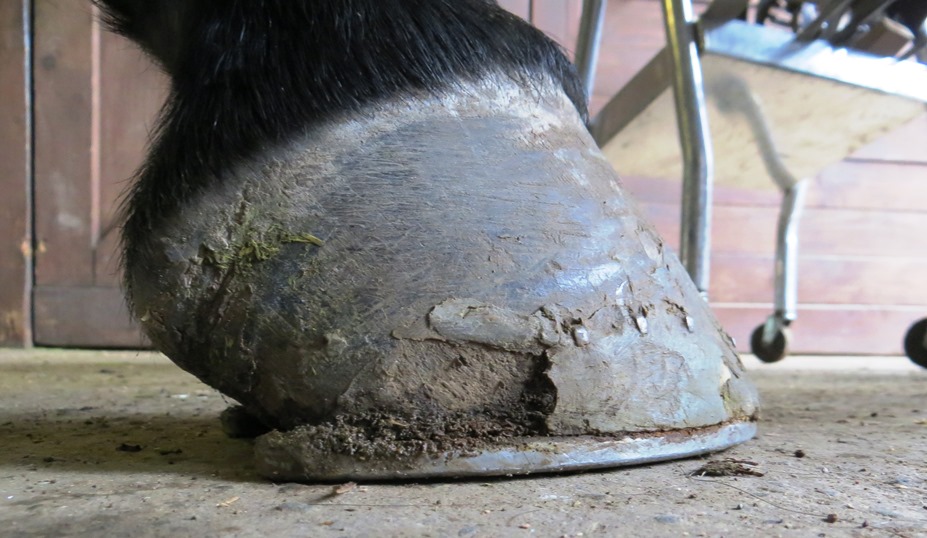
 If you look at the edge of the above photo of his left hind, you can see the 'lip". It's on the toe. This specific photo was taken 15 Mar 15. Below is the same foot,left hind outside, after trimming.


Compare it with the one below, from my post "A picture can cause a 1000 shrieks".
What an improvement!! And below is the photo of his sole, that I shot on 15 Mar 17. The odd coloration is due to the hoof goop's iodine, staining the tissue. I did NOT take pictures of the sole after Matt worked on it. Linea, the barn owner, has a sea of dogs who insist on being underneath one's feet.
When you squat down to take a picture of feet, the dogs take it as an invitation to kiss you. I hate being kissed by a dog. So the pictures didn't get taken.
But you can see that much of the 'garbage', as Matt calls the infected hoof, is gone.


 Below are shots of his right hind, taken last month (or was it January?), which wasn't as bad as the left, but was still not a very good hoof.


    And now, the same hoof as above, before trimming on 15 Mar:
I don't have pictures of this right hind hoof after trimming, but if you look closely, you can see a bit of the lip. Below is the right hind sole from 15 Mar, and you can see the lip on both the right hind and left hind sole.
   We are tickled at the progress that's been made. Even Linea came over and wanted to know what Matt thought. Matt, was..well, encouraged, but wasn't effusive. He's seen a lot of bad feet, and so he advises we stay the course. We'd love to take Raven out of shoes altogether. After coaxing these feet into growing better hoof, I cringe at the idea of putting new holes in them.


    Oh, I forgot to mention, we've also been feeding him a supplement called "Trifecta". It is way spendy, oh my gosh, but it certainly seems to be contributing to the new hoof growth. 

    It seems to me that the right hoof is growing out faster than the left. 
That's merely my pondering, though.

   I wish I'd taken pictures of the soles after trimming. Matt took off the bars. I don't think this is a good idea, but...what do I know. He seems to be fixing the feet, so....I'll keep my humble opinions to myself. 

    Next hoof trimming is on 5 May. The weather is improving and he's been on green grass for some time, so I imagine that will speed up hoof growth, a lot. We'll see.


06 November 2014

The trouble with feet.

     Raven has been in the New Barn for two months or so. Within a week of arrival, he'd torn out the electric fence in his paddock during a fracas with the geldings in the paddock next to his; somehow knocked out a couple fence boards; and unfortunately, strained a ligament in his left fore while acting Big Stud For The Girl Next Door.

     It took a few weeks of confinement to the small turnout pen off his stall and an injection in order for it to heal. But he did heal. So we began to ride, only to discover a new issue: his hind feet are crumbling.


Arrrghhhhhhhhhhh. It's a very bad feeling to see the farrier pull a shoe and part of the hoof falls off.


This comes from one or several of factors: Our wet, wet climate, genetics (to a degree), nutrition, and shoeing.
    In my opinion, it's a combination of 1 and 4. I know Raven's breeding. He's 1/2 Trakehner, 1/2 Thoroughbred. He has virtually no white anywhere on him-just a spot on his lip and a faint star, just a scattering of white hairs that vanish under a winter coat.

     I know what he's been eating for two years. We have never stinted on the best for him. In fact, Sue moved him from Bourbon Stables after the owner decided to save a few bucks (and still charge the same money) by going cheap on feed.  Raven went from locally grown orchard grass and whole oats to the equine equivalent of Doreetohs and Fruit Loups.  (sic) (I misspell purposefully in order to keep the advertisers from hitting you and me with ads.)

Our wet climate keeps the feet wet. Farrier number 1 warned us to keep Raven's  feet as dry as possible. But there's only so much you can do when you live in a gigantic car wash. You don't want to keep him in a stall 24/7. That drives them insane. And kills them.

    Because Sue's former farrier has been unable to work because of his wrists and back, she had to find a new one. After doing a lot of culling, she hired Matt.


     Despite my not being a farrier, I always wondered about how the last farrier shod Raven. He'd always had to build up one of the hind feet with a bit of epoxy, but now it'd gotten much worse.

    In such a small field of work, every farrier knows every other farrier in the region. So Matt was very circumspect in his appraisal of why the hooves are crumbling. He didn't say so, but I know he believes the former farrier was partially to blame. Nor did he imply it in order to keep a new client. He was late to the barn because his prior appointment, one for four horses, was suddenly doubled to eight when 'everyone realized the farrier was there and would you please work on my horse?" I can't blame him for saying yes.


   The discussion between the three of us touched on how Raven had been shod before Matt got the job. Maybe the first farrier didn't allow the heels to adequately expand. Maybe he put too much pressure on the sides. I don't know. But now we have about a year of work to get his feet to grow out. Matt built up the hooves with epoxy and gave me a recipe for goop to put on his hooves to keep them dry, because if 'he stands around in the mud, that epoxy is going to come right out."

    Yes. The recipe is: Mix Venice turpentine and iodine in a 60:40 ratio. For us in the US, that's a cup of turpentine to 5.5 ounces of iodine.

Apply to the soles and on the outside of the hoof, no higher than the nails. Do NOT get it anywhere near the coronary band, as it will burn the tissue. Venice turpentine is made of larch tree resin. Be careful when shopping for it. It's different than the more readily available turpentine used by painters. Venice turpentine is an astringent, and the iodine is to kill bacteria that every horse steps in every single moment of his life. Try not to get it on the frog. Apply about three times a week. (this last is for Raven's case.)

    It could have been worse. Sue doesn't vanity clip him. Meaning, she leaves his whiskers on and never, ever trims his pasterns.


     Some people think that cowlick of hair coming off the back of his pastern is unsightly, and trim it off. Yes, it makes for a 'cleaner, prettier' leg, but that cowlick serves a very important purpose...like a rain chain, it wicks water away from the hoof.


     Extrapolating this in my biologists mind, I wonder if draft horse breeders didn't understand this when they set about breeding draft horses. One can't think of Clydesdales, Shires, and even Friesians without thinking of their 'feathers' (extremely long haired pasterns)

    Sue is upset about it, but I try to tell her it will be okay. It will take time and work, but we'll get him back to good footing. Literally.