There are days when you believe that no matter how hard you try, you just don't GET it.
I cannot remember the number of times I've had an instructor tell me to go through a series of steps in order to do something else(i.e. "pick up the outside rein, cue with your inside calf, sit back, sit forward, etc). I try to follow her 'orders', yet don't believe I've managed. Sometimes the horse obeys, and sometimes..most of the time..he does not. I try and try and when I finally DO get the desired result, the instructor (who has a better eye for another rider's performance then I will ever achieve) says, YES!
"Did you feel that?" I am asked.
No. I honestly don't know how I did it. It's dumb luck. It's probably why I don't have much success with riding, in that I'm inconsistent. But I don't usually admit it, guaranteeing failure.
I must admit that the woman I've taken a few lessons from in the last two years is very good. With her, I'm not afraid to say "No, I've no bloody clue what I did or how I did it." .She's good with that, and tries different things, until I find something that does work, for instance, doing a half halt.
I end up feeling frustrated and at the same time, humbled by my horse's patience with me. Every time I've dismounted from a lesson, I apologize to Raven.
He is so patient with me. He's a gentle but insistent taskmaster. He won't do something unless I ask it correctly. No matter how badly I fumble around on his back, he still has that lovely glint in his eye that says he loves me.
It explains why I don't take that many lessons. I don't even pretend to believe I know more than the instructor. I certainly don't know more than the horse. I'm pretty stupid, actually, and sometimes wonder if I have any business being atop a horse.
But I love them, and I want to ride. So for the last two years (yes), I've been working on me. I've taken a few lessons, more out of a sense of obligation to the instructors, because I don't believe lessons do any good. For me, at least.
This is not hubris, or arrogance. I know damned well I DON'T know better than the instructor. I know my limitations. The hard drive in my head is is full (and always thinking of things other than riding) and I find it hard to follow more than one order at a time.
I've always, always been the type of person who has to learn by doing. I'm terrible at following written instructions, especially complex, multi-stepped ones. I even have to break recipes down into single steps. Being told to do something when I'm attempting to do something else is even less helpful. I know that is ME. It takes a great deal of experience and a talent to be a riding instructor. I don't know how they do it.
Having learned how I learn, virtually all of my riding the last two years has been done bareback, and without a trainer. I want to be able to feel the horse. I want to hear myself. I want to find that balance, that relaxation, that everyone else seems to summon without effort.
Because riding IS an effort. Non-horsey folk think that horse riding is merely a matter of sitting in an expensive saddle and saying 'giddyup'. You and I know much better. It's physical work. It's equal parts athleticism and art. Coming to riding (NOT horses, just riding them) late in life, I don't have that ability to absorb and process the physiological feedback that young children seem to possess in abundance. I'm old. I'm broken in several spots. I am utterly convinced of my vulnerability and mortality.
I can't say, either, that riding bareback at a walk is the most exciting thing I've ever done atop a horse. (THAT was when a neighbor's western saddled Morgan gelding ran away with me, and I enjoyed every bit of it, hanging onto the saddle horn the entire furiously paced trip).
Going back to the basics has taught me something I cannot adequately describe. I can quiet my mind, now, and listen to what Raven's body is saying. I'm very right sided (and right handed) and have to force myself to listen with both sides of me, but riding bareback at a walk has taught me balance without reins, and relaxation.
When I mount, when we first walk off, I drop the reins and just let Raven drop his head and walk out. Only when I'm comfortable and feel secure will I pick up the reins.
Today was sunny but bitterly cold. I hadn't planned on going to the barn, but Sue called me...did I want to ride?
I bundled up in layers and met her. I'm glad we did. Being the only ones foolish enough to brave the sub freezing temperatures, we had the arena to ourselves.
I usually ride Raven first, bareback, to warm him up. Then I'll dismount and Sue saddles him, and makes him work. So it was today.
After fifteen minutes or so, Sue asked, did I want to try trotting?
The last time I tried trotting, bareback, I failed miserably. I quit when I realized I was bouncing right off his back.
But it's been six months or more. Let's put him on a lunge line and try it.
To cut to the chase, it was...fantastic. I finally feel as if my two years of "work' has paid off. Holding onto a clump of mane, one handed, I rode a sitting trot. It was...well, it was a revelation. When I felt myself beginning to fall sideways, instead of tightening up and bending forward, I instinctively relaxed...and leaned back.
Voila a'!!! I was sitting his fast trot. I was SITTING HIS TROT. Bareback.!!
Sue was as ecstatic as I was. She told me later, "I knew right away when you got it, it was all over your face." I was hyped. I'd done the right thing instinctively, not having to THINK 'relax', 'lean back", straighten up. I was ramrod straight. I was relaxed, balanced, I was sitting the trot. I'd done it without thinking. I'd LEARNED.
Keeping him on the lunge line helped. Sue kept him in frame, which helped enormously. When he was carrying himself, stepping underneath himself, the trot felt effortless.
Oh my gosh. THIS is how it's supposed to feel. This is the breakthrough. I'm not afraid. I trust Raven, I trust Sue...I trust myself.
I know most of you, my readers, have been riding for years, and probably don't even remember the moment when you discovered you could actually do something more than a walk on a horse.
For me, it was today.
I hope I don't backslide, but I probably will. It's inevitable, but...I did it once. I can do it again. Because now I know what to do and how to do it. Raven taught me. I taught me.
As an aside, Sue had her seminal moment, too. She mounted a happy, warmed up Raven and achieved something she's been working towards, too. A passage.
Oh my gosh, Raven was gorgeous. What a lovely passage. I could barely keep from whooping in excitement when I saw them passaging across the arena. My gosh, Sue, you missed it, you can't possibly believe how good you two look.
"Oh yes, I can" she said, with the same stars in her eyes that I'd had earlier,'you can't believe how fantastic it feels."
Yes I can. We are miles apart in levels of ability, but yes, I can.
15 November 2014

06 November 2014
The trouble with feet.
Raven has been in the New Barn for two months or so. Within a week of arrival, he'd torn out the electric fence in his paddock during a fracas with the geldings in the paddock next to his; somehow knocked out a couple fence boards; and unfortunately, strained a ligament in his left fore while acting Big Stud For The Girl Next Door.
It took a few weeks of confinement to the small turnout pen off his stall and an injection in order for it to heal. But he did heal. So we began to ride, only to discover a new issue: his hind feet are crumbling.
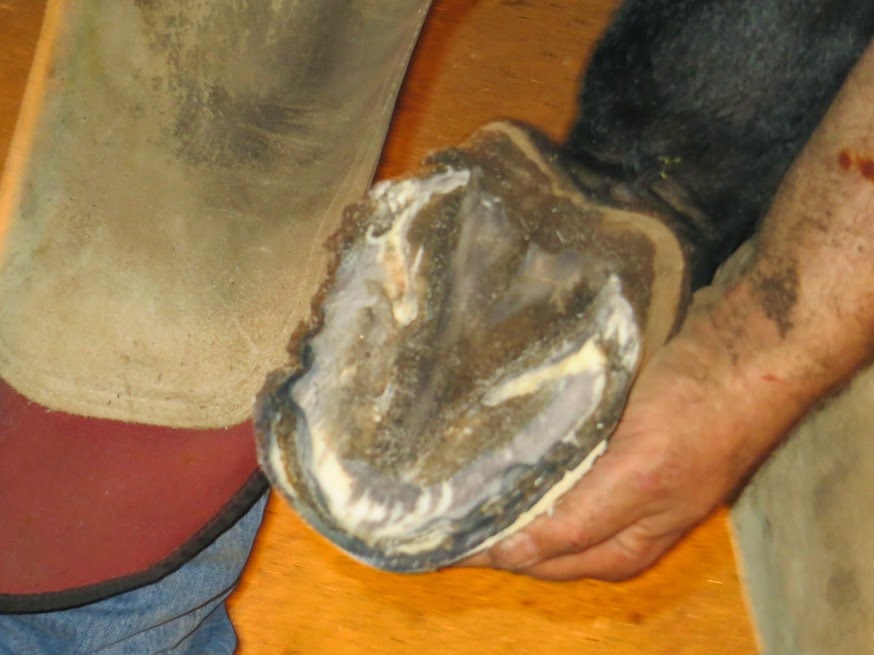
Arrrghhhhhhhhhhh. It's a very bad feeling to see the farrier pull a shoe and part of the hoof falls off.
This comes from one or several of factors: Our wet, wet climate, genetics (to a degree), nutrition, and shoeing.
In my opinion, it's a combination of 1 and 4. I know Raven's breeding. He's 1/2 Trakehner, 1/2 Thoroughbred. He has virtually no white anywhere on him-just a spot on his lip and a faint star, just a scattering of white hairs that vanish under a winter coat.
I know what he's been eating for two years. We have never stinted on the best for him. In fact, Sue moved him from Bourbon Stables after the owner decided to save a few bucks (and still charge the same money) by going cheap on feed. Raven went from locally grown orchard grass and whole oats to the equine equivalent of Doreetohs and Fruit Loups. (sic) (I misspell purposefully in order to keep the advertisers from hitting you and me with ads.)
Our wet climate keeps the feet wet. Farrier number 1 warned us to keep Raven's feet as dry as possible. But there's only so much you can do when you live in a gigantic car wash. You don't want to keep him in a stall 24/7. That drives them insane. And kills them.
Because Sue's former farrier has been unable to work because of his wrists and back, she had to find a new one. After doing a lot of culling, she hired Matt.
Despite my not being a farrier, I always wondered about how the last farrier shod Raven. He'd always had to build up one of the hind feet with a bit of epoxy, but now it'd gotten much worse.
In such a small field of work, every farrier knows every other farrier in the region. So Matt was very circumspect in his appraisal of why the hooves are crumbling. He didn't say so, but I know he believes the former farrier was partially to blame. Nor did he imply it in order to keep a new client. He was late to the barn because his prior appointment, one for four horses, was suddenly doubled to eight when 'everyone realized the farrier was there and would you please work on my horse?" I can't blame him for saying yes.
The discussion between the three of us touched on how Raven had been shod before Matt got the job. Maybe the first farrier didn't allow the heels to adequately expand. Maybe he put too much pressure on the sides. I don't know. But now we have about a year of work to get his feet to grow out. Matt built up the hooves with epoxy and gave me a recipe for goop to put on his hooves to keep them dry, because if 'he stands around in the mud, that epoxy is going to come right out."
Yes. The recipe is: Mix Venice turpentine and iodine in a 60:40 ratio. For us in the US, that's a cup of turpentine to 5.5 ounces of iodine.
Apply to the soles and on the outside of the hoof, no higher than the nails. Do NOT get it anywhere near the coronary band, as it will burn the tissue. Venice turpentine is made of larch tree resin. Be careful when shopping for it. It's different than the more readily available turpentine used by painters. Venice turpentine is an astringent, and the iodine is to kill bacteria that every horse steps in every single moment of his life. Try not to get it on the frog. Apply about three times a week. (this last is for Raven's case.)
It could have been worse. Sue doesn't vanity clip him. Meaning, she leaves his whiskers on and never, ever trims his pasterns.
Some people think that cowlick of hair coming off the back of his pastern is unsightly, and trim it off. Yes, it makes for a 'cleaner, prettier' leg, but that cowlick serves a very important purpose...like a rain chain, it wicks water away from the hoof.

Extrapolating this in my biologists mind, I wonder if draft horse breeders didn't understand this when they set about breeding draft horses. One can't think of Clydesdales, Shires, and even Friesians without thinking of their 'feathers' (extremely long haired pasterns)
Sue is upset about it, but I try to tell her it will be okay. It will take time and work, but we'll get him back to good footing. Literally.
It took a few weeks of confinement to the small turnout pen off his stall and an injection in order for it to heal. But he did heal. So we began to ride, only to discover a new issue: his hind feet are crumbling.
Arrrghhhhhhhhhhh. It's a very bad feeling to see the farrier pull a shoe and part of the hoof falls off.
This comes from one or several of factors: Our wet, wet climate, genetics (to a degree), nutrition, and shoeing.
In my opinion, it's a combination of 1 and 4. I know Raven's breeding. He's 1/2 Trakehner, 1/2 Thoroughbred. He has virtually no white anywhere on him-just a spot on his lip and a faint star, just a scattering of white hairs that vanish under a winter coat.
I know what he's been eating for two years. We have never stinted on the best for him. In fact, Sue moved him from Bourbon Stables after the owner decided to save a few bucks (and still charge the same money) by going cheap on feed. Raven went from locally grown orchard grass and whole oats to the equine equivalent of Doreetohs and Fruit Loups. (sic) (I misspell purposefully in order to keep the advertisers from hitting you and me with ads.)
Our wet climate keeps the feet wet. Farrier number 1 warned us to keep Raven's feet as dry as possible. But there's only so much you can do when you live in a gigantic car wash. You don't want to keep him in a stall 24/7. That drives them insane. And kills them.
Because Sue's former farrier has been unable to work because of his wrists and back, she had to find a new one. After doing a lot of culling, she hired Matt.
Despite my not being a farrier, I always wondered about how the last farrier shod Raven. He'd always had to build up one of the hind feet with a bit of epoxy, but now it'd gotten much worse.
In such a small field of work, every farrier knows every other farrier in the region. So Matt was very circumspect in his appraisal of why the hooves are crumbling. He didn't say so, but I know he believes the former farrier was partially to blame. Nor did he imply it in order to keep a new client. He was late to the barn because his prior appointment, one for four horses, was suddenly doubled to eight when 'everyone realized the farrier was there and would you please work on my horse?" I can't blame him for saying yes.
The discussion between the three of us touched on how Raven had been shod before Matt got the job. Maybe the first farrier didn't allow the heels to adequately expand. Maybe he put too much pressure on the sides. I don't know. But now we have about a year of work to get his feet to grow out. Matt built up the hooves with epoxy and gave me a recipe for goop to put on his hooves to keep them dry, because if 'he stands around in the mud, that epoxy is going to come right out."
Yes. The recipe is: Mix Venice turpentine and iodine in a 60:40 ratio. For us in the US, that's a cup of turpentine to 5.5 ounces of iodine.
Apply to the soles and on the outside of the hoof, no higher than the nails. Do NOT get it anywhere near the coronary band, as it will burn the tissue. Venice turpentine is made of larch tree resin. Be careful when shopping for it. It's different than the more readily available turpentine used by painters. Venice turpentine is an astringent, and the iodine is to kill bacteria that every horse steps in every single moment of his life. Try not to get it on the frog. Apply about three times a week. (this last is for Raven's case.)
It could have been worse. Sue doesn't vanity clip him. Meaning, she leaves his whiskers on and never, ever trims his pasterns.
Some people think that cowlick of hair coming off the back of his pastern is unsightly, and trim it off. Yes, it makes for a 'cleaner, prettier' leg, but that cowlick serves a very important purpose...like a rain chain, it wicks water away from the hoof.
Extrapolating this in my biologists mind, I wonder if draft horse breeders didn't understand this when they set about breeding draft horses. One can't think of Clydesdales, Shires, and even Friesians without thinking of their 'feathers' (extremely long haired pasterns)
Sue is upset about it, but I try to tell her it will be okay. It will take time and work, but we'll get him back to good footing. Literally.
22 August 2014
This most lovely August
“Summertime, and the livin’ is easy,
Fish
are jumpin’, and the cotton is high,
Your daddy is rich, and your momma
good-lookin’,
So
hush, little baby, don’t you cry”
GERSHWIN, IRA / GERSHWIN, GEORGE / HEYWARD, DU BOSE
sung by Ella Fitzgerald
Summers
in the Pacific Northwest have seldom been so hot or long lasting.
Usually,
it doesn’t stop being cold and rainy until the 5th of July. Yes, the
5th. Usually it’s raining and cold when one goes out to see the
fireworks on the 4th.
For
two weeks after the 5th of July, the temperatures are torrid, with
highs sometimes reaching 100 degrees. Being that we are above the 45th
parallel, the same latitude as Frankfurt and Southern England, it shouldn’t be
surprising that our summers are usually short and cold.
Frustrating
my attempts to grow tomatoes, (especially) and other hot weather loving plants,
the thermostat seems to plummet at the beginning of August. Tomatoes and beans
not only like hot temperatures, but they also need a lot of ‘solar units’,
meaning long hours of sunlight. Nope, again, right after summer solstice on 21
June, the PNW sun shortens its work day.
This
summer, however, has been an exception (although I believe it is the first
summer of global warming normal). It got hot in June and has stayed hot. We’ve
had but two days of rain, which we badly needed, as the West (East, to me) is
burning. Literally. Wildfires have consumed over 400,000 acres just in my state
alone.
Still,
true to form, late August still is cooler than July. Today, the temp was 43 degrees and
foggy on our morning walk. It warmed up
quickly, as it has all summer long, and right now is a balmy 74.
Growing
up in the hot, humid, sweltering Midwest, I used to hate August. There was no
escaping the heat (my father couldn’t afford air conditioning), and I used to
suffer headaches that now, I know, were due to dehydration. What did we know
then?
But
now, living in the PNW, I am loving this August. The temperature is perfect.
The California poppies are still blooming, with fat, happy bumblebees wallowing
in them like tiny buffalo. This year’s batch of onions is hardening off in the
sunshine before I split it-half goes into our chest freezer, half goes to the
food bank.
The
lawn and gardens have senesced, meaning the only mowing I need to do is to
behead the weeds. The flowers that aren’t still blooming have gone to seed,
providing us the opportunity to watch goldfinches hanging upside down to
harvest them.
The
bedsheets I washed this morning are drying on the clothes line. I’ll make up
the bed with them this evening, and go to sleep with the scent of sun and wind
in my nostrils.
All my winter bedding, the comforters, the wool blankets, have had a good long day in the sunshine. My feather pillows have had the same treatment.
The
goldfinch babies are now teenagers, no longer begging from their fathers for
food. The ravens are klonking in the trees just beyond our property line.
Despite their predatory ways, I love the ravens, if for no other reason than
they keep the damned crows away. Cooper’s hawks have raised a pair of babies,
and our barn owl babies are still coming out, late, late at night now,
shrieking for mom and dad to bring them a rodent! They’ll be leaving soon, as
will our purple martins. This is the first year I had martins nesting here, and
only one pair raised up a couple of babies. They’re still in the area, getting
ready for their migration to Brazil. They will be back, I know.
While the birds have finished singing their summer songs, the crickets have taken over. There is something about crickets that just sound summery. It's a peaceful sound, a sound you only hear when it's warm, and dry.
While the birds have finished singing their summer songs, the crickets have taken over. There is something about crickets that just sound summery. It's a peaceful sound, a sound you only hear when it's warm, and dry.
The
wasps, as usual, didn’t get really going until the beginning of this month, but
have made up for lost time in an explosion of nests. While I appreciate the job they do killing
nasties such as gypsy moth larvae and cutworms, still…my husband is allergic to
their sting, and I don’t like being harassed when I’m weeding my gardens. They have five acres in which to play, they
don’t need to live in my eaves. We’ve sprayed over a dozen nests, and are still
finding them.
We
are actually getting summer chores done: cleaning and tightening gutters (very
important in our rainy winters),cleaning out the garage (arrgh), fencing the apple trees in hopes we get SOME
of the Liberty’s before the deer do, cleaning bird boxes preparatory to sealing
them off for the winter, putting up corn, marionberries, green beans and
onions, and waiting for my fabulous black beans to completely dry before shucking.
As I write this, we’ve got Jordan’s
shed almost completely dismantled. Tomorrow I take the old siding/rotted out
roof wood to the landfill. Last Tuesday, we’d filled up Tomboy (my trusty
pickup truck) with a load of shingles and tar paper and took it to the
landfill. After handling those things three times in less than 24 hours, I was
glad to see them go for good.
It’s
sad, in a way, to see my beloved geldings’ home taken down, but I know myself.
I won’t be keeping a horse here, probably not ever again. It’s a ton of work,
and my knees, back and shoulders can’t do it anymore.
But,
I have money set aside. If I ever come into possession of a horse, I can board
him for quite some time.
We
battled tansy ragwort on the prairie from late Jun to early this month. We
filled 35 garbage bags with tansy tops and toes, donating over 125 hours to the
non-profit organization that oversees the restoration operations. We are still
hunting for the late bloomers. Whether we’ve made a dent on the infestation, I
don’t know. It’s been a wonderful year for tansy, as well, and it’s evolving to survive hot summers. The cinnabar moths only eat the first flush of tansy flowers, then pupate. The tansy blooms recover almost immediately and try to go to seed. What a bummer. It’s a lot of thankless labor, especially as
it’s all voluntary.
But
the prairie knows. She’s given me so much, how can I not return her generosity
with my own? There is a huge sense of satisfaction to go out on the preserve
and see no tansy, knowing it’s all due to my husband's and my long hours of work.
Besides,
nothing tunes up one’s birding/hunting eye like hunting tansy, a DYC that
sneaks in amidst other DYC’s like St. John’s Wort and ragweed. (for the
non-biologist/botanist/environmentalist/tree hugger, DYC is shorthand for
Damned Yellow Composite, a description of the most common types of flowers.
It’s in the same league as a birder’s LBJ-Little Brown Job ). Not that I intend
on hunting deer this year, although we could use the meat. But we’re
considering a camping trip to California, to see redwoods and wildlife. Migrating fall warblers are hard to spot and even harder to identify, so a sharp eye is a must.
We
have spent the vast majority of the summer outdoors. It’s been fabulous.
I’m
writing this, probably, for myself. Because, in six months, it will be
February, with days just a few hours long, when the sun is down by 4 PM and the skies are gray for months at a time. There will be snow, rain, icy roads, and power failures. The foyer will be cluttered with a dozen pairs of boots
in various stages of wet, drying and dry, the scent of wet clothing ponging the indoor air. We'll have to dress in layers, waddling like the Michelin Man, but not so cheerfully. Doing anything outside will be an exercise
in exposure to the elements.
Riding will be an effort. Horses don't really care to have an icy cold bit put in his mouth. Cold leather tack is frustratingly hard to work with. One either fumbles trying to buckle a bridle with gloves, or freeze one's fingers (or worse, tear off a fingernail) if one tries it barehanded. Blankets get wet and stay wet, adding a hundred pounds to your efforts at caring for your horse. You worry about horses not drinking enough, muddy paddocks sucking the shoes right off his feet, not daring to do anything more than a tentative walk for fear of his slipping and falling on ice, rain rot if he's not blanketed, icy conditions keeping him in his stall, and wondering if it's worth driving in the rain, the snow, the dark to look at a horse you don't ride in the winter.
So, I suppose I am blogging for myself.
I will scroll back through my list of posts, and see this title, and read it, remembering this lovely day.
Riding will be an effort. Horses don't really care to have an icy cold bit put in his mouth. Cold leather tack is frustratingly hard to work with. One either fumbles trying to buckle a bridle with gloves, or freeze one's fingers (or worse, tear off a fingernail) if one tries it barehanded. Blankets get wet and stay wet, adding a hundred pounds to your efforts at caring for your horse. You worry about horses not drinking enough, muddy paddocks sucking the shoes right off his feet, not daring to do anything more than a tentative walk for fear of his slipping and falling on ice, rain rot if he's not blanketed, icy conditions keeping him in his stall, and wondering if it's worth driving in the rain, the snow, the dark to look at a horse you don't ride in the winter.
So, I suppose I am blogging for myself.
I will scroll back through my list of posts, and see this title, and read it, remembering this lovely day.
Oh, August, month of barbecues and home made lemonade, of sunscreen and clear blue
skies, spiders weaving webs on my lawn mower, gossamer shining in the evening sunshine, watching the cats stalk grasshoppers and
preying mantises in this, the Year of the Horse (2014). August, here’s to you. It's been lovely.
21 August 2014
Stolen tack is jinxed
Raven recently moved into a new barn (which I'll call The Barn, as it's privately owned.)
It's a well kept facility. I know several of the women who already have their horses there, some for years. They're all honest people.
Last week, the owner hosted a tack sale. Signs were posted on the road and I was invited to add whatever I wanted to sell.
Due to a prior commitment, I was unable to stay for the sale. So I put only one item in the sale: my 22" Albion padded leather girth. I used it no more than five times, and then changed horses. I've been trying to get rid of it ever since I sold the saddle, because it fits Arabians, not the big warmbloods I've been riding since.
The day after the sale, I went back to the barn, and my girth was not to be found amidst the other items that hadn't sold.
The story (and I have no reason to disbelieve the barn folk), is that a woman showed up with several kids in tow. She wandered the barn aisle, looking at the tack, and showed an interest in the several girths for sale, to include mine.
Just before she left, the kids suddenly went berserk. There were '3 or 4', that rampaged through the barn, one went running to see the horses in their paddocks, another tried to go up into the haymow, etc.
These actions were planned. The barn folk's attention were drawn to the kids, NOT the woman. Within a few minutes, the woman called her kids back to her side, seemingly embarassed, and used that as an excuse to leave.
One of the barn folk said, 'I didn't like the looks of her right from the start.'
It was only the next day that we realized that my girth was missing, and no one had purchased it.
The woman had stolen it.
Well, let me tell you something, Momma Thief. It's a horrible example you're setting for your kids. I'm betting in the future, I'll be paying for them in the way of keeping them fed in prison.
It's not the fact that I'm out a girth that pisses me off-I wasn't using it. It's the fact that you stole at all.
I wanted to sell it. Despite the fact that it cost me $175 new, I was willing to let it go for $65, and was willing to accept a reasonable offer.
But no, you had to steal it. You went in with full intentions of stealing something. It's why you brought your kids. You've done this before, haven't you? My friends at the barn were amazed at how the kids all scattered at once, in four different directions. You've trained your kids to be accessories to theft.
Let me warn you, Thief. Stolen tack is jinxed. Yeah, I just made that up, but I want to throw that little bottle out onto the internet sea. If you steal tack, that item is is going to have its revenge: fall apart when you need it to stay together. Break when it's the most inconvenient. Lead someone else to steal everything you own. Or, maybe, if you're stupid enough to put it on Craig's List, lead the police to your door. (I bet they already have your name and address on speed dial.)
Stolen tack is cursed with bad juju, and I hope, woman, that it hits you.
Thief, (I can't call you "lady" or "ma'am", as they are honorifics), just remember, Karma will get you. It will. What goes around, comes around. It always does.
Bad luck to you, thief.
It's a well kept facility. I know several of the women who already have their horses there, some for years. They're all honest people.
Last week, the owner hosted a tack sale. Signs were posted on the road and I was invited to add whatever I wanted to sell.
Due to a prior commitment, I was unable to stay for the sale. So I put only one item in the sale: my 22" Albion padded leather girth. I used it no more than five times, and then changed horses. I've been trying to get rid of it ever since I sold the saddle, because it fits Arabians, not the big warmbloods I've been riding since.
The day after the sale, I went back to the barn, and my girth was not to be found amidst the other items that hadn't sold.
The story (and I have no reason to disbelieve the barn folk), is that a woman showed up with several kids in tow. She wandered the barn aisle, looking at the tack, and showed an interest in the several girths for sale, to include mine.
Just before she left, the kids suddenly went berserk. There were '3 or 4', that rampaged through the barn, one went running to see the horses in their paddocks, another tried to go up into the haymow, etc.
These actions were planned. The barn folk's attention were drawn to the kids, NOT the woman. Within a few minutes, the woman called her kids back to her side, seemingly embarassed, and used that as an excuse to leave.
One of the barn folk said, 'I didn't like the looks of her right from the start.'
It was only the next day that we realized that my girth was missing, and no one had purchased it.
The woman had stolen it.
Well, let me tell you something, Momma Thief. It's a horrible example you're setting for your kids. I'm betting in the future, I'll be paying for them in the way of keeping them fed in prison.
It's not the fact that I'm out a girth that pisses me off-I wasn't using it. It's the fact that you stole at all.
I wanted to sell it. Despite the fact that it cost me $175 new, I was willing to let it go for $65, and was willing to accept a reasonable offer.
But no, you had to steal it. You went in with full intentions of stealing something. It's why you brought your kids. You've done this before, haven't you? My friends at the barn were amazed at how the kids all scattered at once, in four different directions. You've trained your kids to be accessories to theft.
Let me warn you, Thief. Stolen tack is jinxed. Yeah, I just made that up, but I want to throw that little bottle out onto the internet sea. If you steal tack, that item is is going to have its revenge: fall apart when you need it to stay together. Break when it's the most inconvenient. Lead someone else to steal everything you own. Or, maybe, if you're stupid enough to put it on Craig's List, lead the police to your door. (I bet they already have your name and address on speed dial.)
Stolen tack is cursed with bad juju, and I hope, woman, that it hits you.
Thief, (I can't call you "lady" or "ma'am", as they are honorifics), just remember, Karma will get you. It will. What goes around, comes around. It always does.
Bad luck to you, thief.
Subscribe to:
Posts (Atom)