11 December 2015

After a year of farrier science.

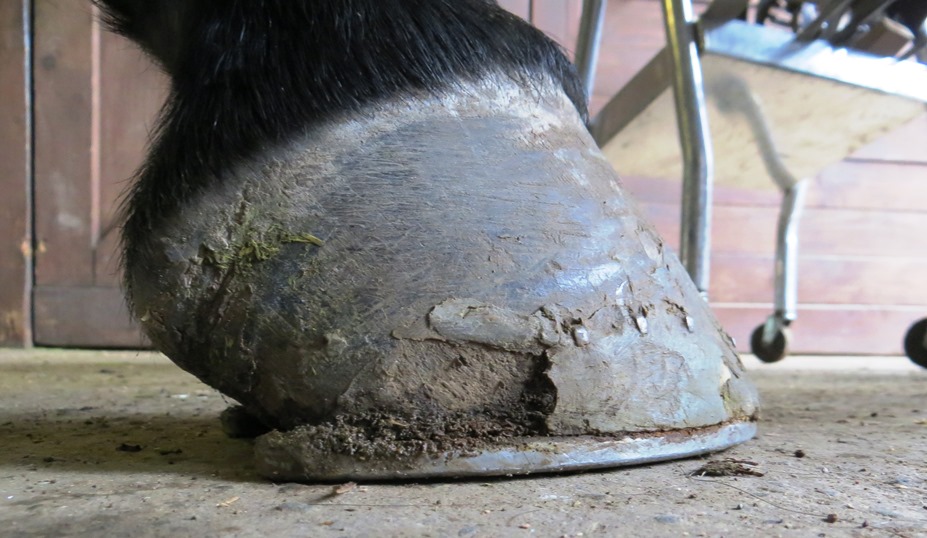
    Last year, (2014) we realized that we had to do something about Raven's feet. I've documented it before. 

    He was trimmed last month, I've just now gotten around to writing it up.

    With good trimming, and supplementing his diet with biotin, Raven's feet have improved immeasurably.

    I wish I had started taking decent pictures of them in November 14, when we first began a dedicated course on fixing his feet. Thus, the pictures that are usable begin in January.

  It's been a year. Here is what we began with in January 15, and what we have now:

Left hind outside post trim Jan 15

Left hind outside post trim Nov 15

Left hind inside pre-trim Jan 15

Left hind inside post trim Nov 15

Right Hind outside pre trim Jan 15

Right hind outside post trim Nov 15

Right hind inside post trim Jan 15

Right Hind inside post trim Nov 15

     As the television ad used to say, isn't that amazing?. With the exception of the RH outside, these are now normal hooves. The RH outside seemed to have weaker hoof growth.Not sure why, but horses feet are individuals. So Mark plans on putting shoes on the hind feet for maybe two trims, just to bolster that last bit that needs to grow out. 

   Over and over again, I am amazed..and grateful that we ditched the old farrier for Mark. Old Farrier was over his head with Raven's feet. They were so very bad...the pics in January don't do it justice. We cleared up the white line disease. We got rid of the thrush. Little by little, Mark has reshaped the hoof, bringing the lines back into alignment, putting those heels back on the ground where they belong.
Raven is going much better now. I'm sure he's forgotten how bad his feet were. 

   Will I take more pictures on his next trim in February? Probably, but whether I post or not, I don't know. After all, with the exception of the RH outside, these are GOOD FEET.

10 December 2015

My best teacher is the one underneath me


    The saying is that one doesn’t really gain mastery of a skill until she’s done it 10,000 times.

    It may be so. What it is saying is that one must practice, practice, and practice. I know this works. There are skills I learned in the military that I practiced so often that they did become automatic. For instance, I can probably still strip down-and re-assemble-an M-16 with my eyes closed, even so many years after retiring from the military.

   I now know, too, that as one ages, that ability to gain and keep a skill, such as riding, seems to take longer.

   Riding, for instance.

   I got back into horses in early 2011. I had never been good at riding before, as I’d not been a regular rider as a kid. Nor had I lived in an area where there were horses, or when I did, I couldn’t afford lessons, or, while in the military, didn’t have the time.

   The children who are blessed with riding lessons in their early days are truly lucky. Most of the horsemen I know are like me: they had lives that didn’t include horses up until their children left home and they had enough time and money to indulge in their passion.

   I owned Jordan for the last five years of his life, and rode bareback, but I was still working and didn’t have an arena in which to ride.

  So. I’ve been riding, mostly bareback, since 2011. I’ve had a few lessons, picked up several good books, but still, I’ve relied mostly on just getting comfortable on a barebacked horse.

  At times I’ve grow discouraged. I will never get this, I would think. I certainly don’t have ten thousand hours atop a horse, even at this point. I’m old enough, though, to know that, starting so very late in life, I will NEVER be the rider I see all around me. If I can be a little bit better than I used to be, that is good enough for me.
I didn’t put a deadline on my desire to be a better rider. I decided, I won’t push it. I will relax and just enjoy the feel of a good horse underneath me.

   It was with a sense of astonishment, and I should say, pride, when I made a breakthrough last month. I have found my core and can engage it. Why that makes a difference, or whether it does, I don’t know. I don’t really think it matters, despite the fact that it seems to be the cause de jour lately.

   I was riding Raven, bareback. We were alone. I have been practicing turning him and moving him without reins. He’s so very patient and willing for me. He’s a good horse.

   I-and I hate to use the word suddenly as often as I’m going to in this post- but I suddenly felt as if I was truly plugged into his spine. I’ve had brief glimpses of this feeling, but this time it wasn’t ephemeral, here and gone like mist in the wind. No, this time, that feeling of my spine being connected to his in one fluid, crystalline piece was here. I was balanced. I was IN the horse, not on him. I was amazed. I lifted both my legs off his sides and wagged them back and forth and felt as solid on his back as if I were truly plugged into him. He spooked at something, went sideways, and I hardly moved. I even laughed.  It was a lovely feeling.

   Three days later I got back on…and felt it again. And the next time. And the next.

I am balanced. I am comfortable on his back. This feeling, it’s here to stay. I have finally learned to sit on a horse.

   That was more than enough for me. I felt proud. My patience and Raven’s teaching had finally been translated into muscle memory. My confidence has climbed several notches.


   I wasn’t done with breakthroughs.

   Two days ago, I led Raven into the arena. I hadn’t planned on riding. It was raining very hard, the wind was blowing into the arena, and all the horses have been confined to quarters, because our monsoon has arrived and the paddocks are fetlock deep in water.
   Raven is a horse who wants and needs work every day, and I knew he was very fresh. I thought it’d be safer to just lunge him.
   Raven, though, had other plans.

   He dislikes ‘dope on a rope’. Sue can free lunge him, but I am not that adept at it, so I tacked him up with a lunge line and asked him to ‘walk on.”

   He turned and faced me.

   No.

    It wasn’t arrogance, or stubbornness, or an obstinate refusal. It was just a polite no.

    “Come on, Raven, walk on.”

     His warm brown eyes bored into mine.

     No. Get on.   

    “Really, Raven? Don’t you want to work?”

     Get on. I have something to teach you.

   Okaaaaaaaaaaay. So I untacked him, left him free in the arena while I ran for my bridle and helmet. When I returned I could see he’d rolled, which I had hoped he’d do. It’s good for their spine, and I suspect he’s not had a good roll in three days.

   I bridled him and mounted. The wind was howling louder than the rain, but I trusted him to be calm as always.

  I settled myself. I always give him a carrot per side, reward for standing until I’m ready to move off. Seat bones? Got ‘em. Core? cough cough there you are. Arms, click click cuffed to my ribs. Shoulders back, head up. Breathing? Nope, I still to this day can’t remember to breathe when I ride. Someday I’ll pass out and fall off.

    We walked off, sans reins. I like to let him drop his head, stretch his topline, and just generally walk the kinks out before I touch a rein.
   I’ve been practicing my hands. I imagine my upper arms to be handcuffed to my ribs. I pretend I am holding a baby chick in each hand. Now I can feel Raven’s mouthing the bit. That’s a new one, too.

   Once we were both settled and ready to ‘’’work”” I picked up the reins. I cheated by looking at where I try to keep my thumbs on my laced reins. (I love laced reins, more for their looks than anything else, but having a definite spot for my thumbs helps me a LOT). C’mere, chicks, hop into my hands, we’re going for a ride.

   After several rounds of the arena, I thought, what happens if I just gently squeeze those chicks. Not even to hurt them, just to see what happens.  

   I have to explain a failing of mine. I don’t take verbal instructions very well. It’s not obstinacy, or arrogance. I just get easily confused, especially if the instructions are multi-faceted, as riding almost always is. It’s hard for me to put two legs, two arms, two hands, all doing different things at the same time. Let’s not forget that I must also think of seat bones and weight shifts and which side is out and which in.

   Thus, when taking instruction or lessons, I’ve listened and reacted backwards. I would tell my teacher, I want to learn to do a half halt. (a subject always one of contention. Every rider I’ve ever met does a half halt differently and can’t tell you how. They just Do it.) So my instructor would say, do this, do that, do the other thing…THERE! Did you feel it?

   Well, no. I’ll say “yes” but I know I didn’t do it. I think, I’ll memorize what she just said, and I’ll repeat it the steps in order, and by reverse engineering, I should get the same result.

   But it doesn’t ever work right. I’ll do it the same way and if I’m alone, Raven continues on serenely as if I never asked a thing. If I’m being taught, I eventually get a GOOD, you did it! But I am lying to her.

   It’s a case of Raven figuring out what I want, due to the instructor’s voice, and he does it. Hey, don’t laugh. This is a horse in front of whom we must spell ‘c-a-n-t-e-r’  because he loves it and will at the mere breath of the word. One of these days he’ll figure it out. He already knows “C”. The rest will come, sooner than later.

  I think Raven just responds because he hears me wishing he would do it. We both know I didn’t make him do it, I didn’t do the steps right or at all. He’s just a kind, loving teacher.  

   Which is another reason I prefer riding bareback, and alone. I can fumble along, take things at my own pace. If I accomplish nothing but enjoy the ride, and he’s happy, I’m good.

    But this time…this time I was listening to him. I squeezed the reins, gently…and felt SOMETHING. Something Different. Something…collected.  

   What do you feel?

   “Oh my god, Raven, what did you just do? Can we do that again?”

   Can YOU?


   It wasn’t until late that night, in bed, that I, rehearsing what I’d felt, finally understood a phrase I’ve heard so often but have never experienced. 

 I dropped the reins, we did another round of the arena, then I picked them up and asked the same way.


   I felt Raven “come up underneath me”. His ears were pricked forward, his neck arched so beautifully and for the first time in my life, I knew I was riding a collected horse.

   I finally know the best teacher I will ever have is the one underneath me.

   I might finally be on my way to learning how to ride.


26 September 2015

You have to see "Unbranded"

     Horse movies are notoriously unreliable. (I know, an oxymoron). They're too weepy, too syrupy, too unbelievable, just TOO. Sometimes, as in the case of "Secretariat" or "Seabiscuit", the horse is distinctly a side character, merely the base for what was, in reality, a chick flick with horsehair. Up until now, the only horse movie I truly liked was "War Horse". While it had some stretches of incredulity, in general it was probably the best horse movie I'd ever seen.

   Now I've seen another.

   Last night I watched "Unbranded". This isn't a movie. It's a documentary. Produced by a wildcat bunch under the moniker "Fin &Fur Productions", "Unbranded" was funded by Kickstarter!

    "Unbranded" documents the efforts of four Texas A& M graduates to train and ride 10 mustangs across the U.S., from the Mexican border to the Canadian. 

(for my European readers, Texas A&M is an 'agricultural college" in Texas. Students are known as "Aggies". For the life of me, I cannot find what the M stands for unless it's Machinery. I don't know. But I do know that the college is primarily one for students of the land: farmers and ranchers. They have a veterinary college, I think) (The Aggies, too, have an undeserved reputation for being louts and clods. One of the many Aggie jokes is: Why does Aggie football stadium have synthetic turf? To keep the cheerleaders from grazing during half time.)

   The leader of the group, Ben Masters, has a dream...to adopt ten mustangs right off the range, break and train them to ride and pack, and then ride them from one border to the other. He recruits three other graduates. The horses are chosen from bands rounded up by the BLM (Bureau of Land Management), trained for 90 days by professionals to accept saddle and bridle, and then off they go.

   They set off from somewhere in Arizona. This is the shakedown part of their so called 'cruise. They stick mostly to game trails and Forest Service roads. Indeed, almost all of their journey is in the backcountry (although I'm certain in some spots they had to be on pavement). As they progress north, you can see the men changing, maturing from college punks to men. As well, the horses change, too. They stop being green broke mustangs and turn into reliable saddle horses. Of course, being that they're riding, you see some incredibly beautiful scenery. You also see some hair raising terrain. You honestly wonder how in the hell did the horses make it across that part. 

    If nothing else, the movie demonstrates the incredible durability, the settled minds, the very essence of what makes a mustang a mustang. Your typical Quarter Horse in the barn would never have made the trip. These horses are TOUGH.  They have good minds. They don't scare at much (except helicopters, dirt bikes and quads...machines used to chase them into captivity.). They're in incredible physical condition and almost all of them made the 3000 mile trip without problems.

   As it's a documentary rather than a scripted movie, much of what's going on in the men's heads is left to the viewer. Still, it's so well produced it feels scripted.
Master's dream was for the same ten horses to go from border to border, with the same four men. You and I, being horsemen, know that Things Happen when horses are involved, and they do. I will tell you that while they ended the trip with ten mustangs, it wasn't with the same ten they began with. One had to be dropped because one of the young men failed to heed Wise Horseman's rule of never turning a horse out wearing a halter. 

 The movie is seamless, carries the plot from start to end, and is at once entertaining, informative and very, very good.  

"Unbranded". See it.

31 August 2015

My farrier works miracles (slowly)

   I have to 'post and boast'.

Raven the Beautiful 

     Look at this gorgeous beast. This was taken in July at a local dressage test. Raven was wired to the max. My gosh, he was high voltage. Sue even wondered if she should do the second test on him, he was so much horse. But we encouraged her to do the test and she came out of it with some very high marks indeed.

     I have made some big steps in riding him. I took a lesson from our super trainer and she's helped me a lot. I am even riding him at the trot bareback, having finally been able to make that transition. Literally. 
My hardest part right now is collection. I still don't have that feel for when he's truly up underneath me. As I noted in my last post, he is not an easy horse to ride. He's long backed, which makes it more difficult for him to collect, and I'm not rider enough..yet... to know it when he is.
But when I do it right, and we're trotting, suddenly it's easy to ride him. Those moments are fleeting yet exhilarating when they do come. They keep me motivated.

      Last year at this time he had just settled into his new home at New Barn. In January we realized that his feet were deteriorating so quickly that soon he would be lame. So we changed farriers. Matt, our new farrier, took Raven's feet as a challenge and ...well, here are some photos of then and now.

     I have, in the past, kept a running account of the progress on his feet. I will condense that to the worst of his hind feet, the left hind. This is a picture of his hoof from January 2015, after we'd been dinking around with the feet for six months of the old farrier. I cannot remember if this was taken before his trim or after. I believe, judging from the fuzz on the ground, that it was after. It was also after we'd given up on the epoxy in his feet.
 
Left hind outside January 2015  
      I still cringe when I look at this. It was so bad. It had white line and, now we know, thrush as well. The crevices were from nail holes that had rotted out. Literally. So we took him out of shoes permanently. Old farrier had steadfastly warned us that "this horse can never be barefoot." With this foot, there was nothing left for a nail to hold onto, as was evidenced in the right hind, which isn't pictured here.

       Now look at this same hoof, 7 months later, after trimming:
Left hind outside post trim August 2015


 To quote an old tv ad.."Isn't that amazing'"

     It IS. We've been feeding him Trifecta, a supplement that contains biotin. We know now that he must have biotin for the rest of his life. Small price to pay for a good hoof. 
We also give most of the praise to Matt, our Wonderful Farrier. He had the courage to take on these ugly feet. We obeyed his 'commands' in dosing the white line, the thrush, and keeping the hoof dry with his concoction of Venice Turpentine/Iodine. 

    What? Yes, it is. It's the same foot. I swear. 

     Matt has done miracles. Notice how he also has slowly improved the angles of the foot to what they're supposed to be. Old farrier had paid so much attention to the 'rotten' parts of the hoof that he trimmed them to the point where there was no heel contact. The heels were contracted. 
     Matt has gently and slowly brought the hoof back into alignment. The heels are opening nicely and in contact with the ground now. He will never go back into shoes. He doesn't need them, and in another few months we hope to take his fores out of shoes, too. The only problem they had was again, Old Farrier had trimmed them to the point where they were beginning to club. 

   Raven is very happy in his new feet. Earlier this month, he was busting around in his paddock with his buddy and tore up the outside. But it was, in my opinion, the very last parts of the old bad hoof. Within days the bent up portion had worn off without damaging the underparts.

   These are new feet. 

    I'm telling you. If and when you find a GOOD farrier, treat him like a king. (well, you know what I mean.) Matt has our business for as long as he wants to keep us. They're minting new veterinarians every year, but I cannot think of more than one young man who is taking on the job of farrier. Every other one is in his early fifties and older. Horseshoeing is part science, part experience, part empathy, and a little bit witchcraft. It uses the same tools as from five hundred years ago. It's archaic. It's also a science, and an art. When you find that man who can do the job right, treat him nicely. You won't regret it.